PFAS Water Filtration in Waltham, MA
Looking into water filtration for PFAS? PFAS are a large group of manufactured chemicals that have been used in industrial processes and consumer products. Certain PFAS can enter drinking water sources, and reducing exposure may be an important consideration when testing identifies a concern.
Some water filtration systems are designed and certified to reduce specific PFAS compounds. Waltham Water Filtration Co. helps homeowners explore PFAS drinking water filtration, testing, and treatment options and connect with independent water treatment providers serving Waltham, Massachusetts.
Whether you're comparing filtration technologies, reviewing water testing information, or considering a new drinking water system, call to discuss your needs.
- PFAS Filtration Options
- Reverse Osmosis Systems
- Activated Carbon Filtration
- Water Testing Guidance
What Are PFAS in Drinking Water?
PFAS stands for per- and polyfluoroalkyl substances — a large group of human-made chemicals used in various products and industrial applications.
Many PFAS persist in the environment. Some have been associated with adverse health effects, and regulatory agencies continue to evaluate different compounds. PFAS have been used in:
- Water-resistant materials.
- Stain-resistant coatings.
- Certain food packaging.
- Industrial manufacturing.
- Certain firefighting foams.
- Other consumer and commercial products.
Two widely studied PFAS are:
PFOA
Perfluorooctanoic Acid
PFOS
Perfluorooctane Sulfonic Acid
These compounds are among those addressed by federal drinking water regulations.
Not all PFAS have identical properties or health effects, and regulatory agencies continue to evaluate different compounds. PFAS cannot reliably be identified by looking at, tasting, or smelling drinking water. Testing using appropriate laboratory methods is needed to determine whether particular PFAS compounds are present. Not all drinking water contains dangerous PFAS concentrations.
What Should Waltham Homeowners Know About PFAS?
Waltham receives its municipal drinking water from the Massachusetts Water Resources Authority (MWRA). MWRA conducts water quality monitoring and publishes results for PFAS.
According to MWRA's published PFAS information, its testing has found the compounds addressed by applicable drinking water standards either at nondetectable levels or at very low trace concentrations. MWRA reports that its fully supplied communities meet the PFAS drinking water standards covered by its published monitoring.
A PFAS filtration system should not automatically be presented as necessary for every household receiving Waltham municipal water. Homeowners may still want to understand their treatment options, review the latest monitoring results, or investigate property-specific water sources. Properties using a private well or another water source may have different testing needs. Anyone concerned about PFAS should begin by reviewing available water quality information and identifying whether testing or treatment is appropriate.
Non-detect results depend on laboratory reporting limits and do not necessarily mean a concentration of exactly zero.
Waltham Water Filtration Co. helps homeowners explore PFAS filtration options and connect with independent providers who can discuss testing and treatment.
Massachusetts PFAS Drinking Water Standards
Massachusetts regulates specified PFAS compounds in public drinking water. Federal regulations also include standards for individual compounds.
Massachusetts PFAS6 standard
Massachusetts established a PFAS6 maximum contaminant level of 20 parts per trillion for the combined concentration of six specified PFAS. A part per trillion is a very small unit of concentration, and the state PFAS6 standard is a combined measurement for those six specified chemicals — not a separate 20 ppt allowance for each.
Federal PFAS regulations
Federal PFAS drinking water regulations include standards for individual compounds. The EPA established maximum contaminant levels of 4 parts per trillion for PFOA and PFOS. In May 2026, EPA proposed revisions to implementation requirements and certain other PFAS regulations. A proposed extension to 2031 does not automatically apply to every public water system. Because PFAS regulations may continue changing, review current official regulatory information rather than treating all compliance deadlines as permanent facts.
Current enforceable requirements are distinct from proposed changes. Review official regulatory sources for the latest status.
What Types of Water Filters Can Reduce PFAS?
Different filtration technologies can reduce particular PFAS compounds. System effectiveness depends on the contaminants, equipment design, operating conditions, and verified performance claims.
Activated Carbon Filtration
Granular activated carbon, also called GAC, is used in certain water treatment systems. PFAS compounds may adsorb to the carbon as water passes through.
Performance depends on carbon characteristics, filter contact time, water flow, filter capacity, water chemistry, the specific PFAS compounds, and maintenance. Not every carbon filter is certified for PFAS reduction, and some short-chain PFAS may be more difficult to reduce using certain carbon systems.
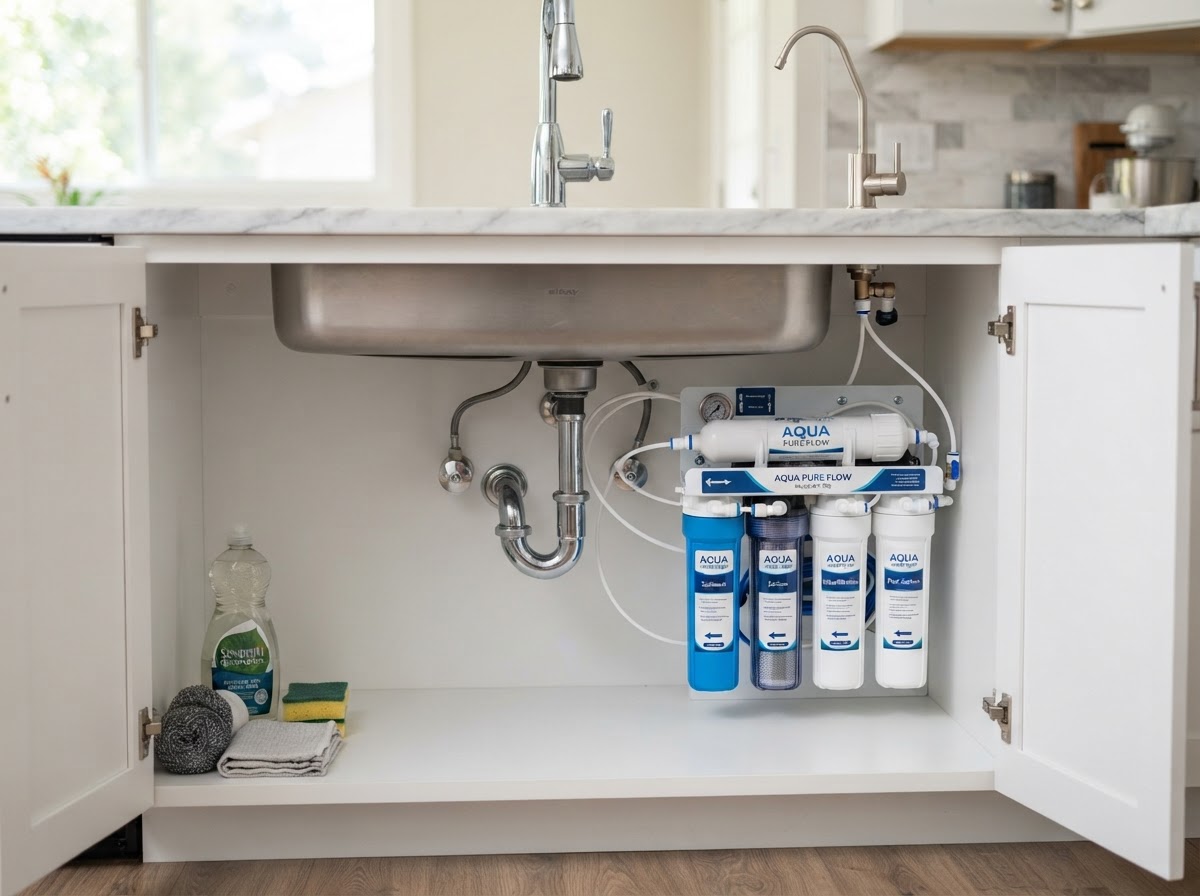
Reverse Osmosis Systems
Reverse osmosis systems use a semipermeable membrane to separate treated water from a reject-water stream. Certain RO systems are certified for reducing PFOA, PFOS, or other specified substances.
Residential RO systems commonly provide drinking water treatment at a kitchen sink. They require filter and membrane maintenance and produce reject water. Not every RO system has the same contaminant-reduction certification.
Explore reverse osmosis systemsAnion Exchange Filtration
Some PFAS treatment systems use specialized anion-exchange resins designed to capture negatively charged PFAS compounds. These are different from conventional cation-exchange water softeners used to reduce calcium and magnesium hardness.
Performance depends on resin design, water chemistry, contact time, and the specific PFAS involved. An ordinary residential water softener is not a PFAS filter.
Multi-Stage PFAS Treatment Systems
Certain systems combine several treatment technologies. For example, a system may use sediment prefiltration along with a specialized carbon or membrane treatment stage.
The purpose of each stage should be clearly defined. More stages do not automatically mean better PFAS reduction. Choose equipment based on product-specific verified performance rather than stage count alone.
How to Choose a Certified PFAS Water Filter
A water filter labeled as certified is not automatically certified for every contaminant. Customers should check the exact reduction claims.
NSF/ANSI 53
Covers specified health-related contaminant reduction claims. Certain systems certified under this standard have verified PFAS reduction claims.
NSF/ANSI 58
Covers reverse osmosis drinking water systems. Some RO systems certified under this standard have specified PFAS reduction claims.
Certification to either standard alone does not guarantee PFAS reduction. The specific model must carry an applicable PFAS reduction claim. Certification testing criteria and regulatory drinking water limits are not always identical, so a general NSF certification does not by itself confirm a product meets the latest EPA numerical PFAS limits.
Under-Sink or Whole-House PFAS Filtration?
The best option depends on the homeowner's goals, testing results, exposure considerations, system performance, and provider recommendations.
Under-Sink PFAS Filtration
- Treats water at a specific drinking water faucet.
- May use certified carbon or reverse osmosis equipment.
- Commonly selected when drinking and cooking water are the primary concern.
- Usually requires less equipment than whole-house treatment.
- Requires scheduled filter maintenance.
- Has product-specific contaminant reduction capabilities.
Whole-House PFAS Filtration
- Treats incoming water before it reaches multiple household fixtures.
- May use specialized treatment media.
- Requires appropriate sizing for household flow.
- Can involve larger equipment and more extensive installation.
- Requires consideration of media life, maintenance, and performance monitoring.
- Is not automatically necessary for every residential property.
The best option depends on the homeowner's goals, testing results, exposure considerations, system performance, and provider recommendations. Whole-house PFAS filtration is not always better or always required.
Should You Test Your Water for PFAS?
Testing may be useful when homeowners have a specific concern about PFAS or use a water source without routine public monitoring. For municipal-water customers, reviewing the latest utility testing information is a sensible first step. For private water sources, property-specific testing may be more important.
PFAS testing requires appropriate laboratory methods. Most ordinary home water test strips cannot reliably determine PFAS concentrations. The laboratory must be qualified for the requested analyses, and the sampling instructions must be followed carefully. The testing method may evaluate a specified list of PFAS rather than every PFAS compound in existence. Testing results may be reported in parts per trillion, and the detection and reporting limits matter when interpreting results.
What Is Involved in PFAS Water Filter Installation?
Installation considerations vary by system type, water source, and treatment goal.
Treatment Goal
The chosen system should target the particular substances of concern.
Water Supply
Public water and private well systems may require different evaluations.
Equipment Location
Under-sink systems are commonly installed near the drinking water faucet. Whole-house systems are generally installed near the incoming main water supply.
Plumbing Requirements
Installation may involve suitable supply connections, mounting, dedicated faucets, drainage, or other components depending on system type.
Flow and Capacity
Equipment must accommodate expected household water use.
Certified Components
The installed configuration should preserve the equipment's verified contaminant reduction performance.
Maintenance Access
Filter cartridges, membranes, or treatment media must remain accessible for maintenance.
Post-Installation Requirements
Follow manufacturer instructions for flushing, commissioning, filter changes, and any appropriate performance testing.
This page does not provide detailed DIY plumbing modification instructions. Not every installation uses the same equipment or requires identical work.
How Often Do PFAS Water Filters Need Replacement?
Filters used for contaminant reduction have finite service capacities. Maintenance requirements depend on:
- Filter type.
- Equipment model.
- Rated capacity.
- Water usage.
- Incoming PFAS concentrations.
- Water chemistry.
- Manufacturer instructions.
A filter may continue passing water after its intended reduction capacity has been exhausted. Reverse osmosis systems may have different replacement intervals for their prefilters, membranes, and post-filters. Carbon-based systems may require cartridge or media replacement, and certain larger systems may require specialized maintenance or monitoring. There is no one universal schedule for all PFAS filters, and water tasting normal does not prove the filter is still reducing PFAS. Follow the manufacturer's approved replacement schedule and disposal instructions — requirements can vary by filter type and local rules.
How Much Does PFAS Water Filtration Cost?
Pricing varies based on the treatment technology, equipment capacity, installation requirements, and ongoing maintenance. Customers should compare total ownership cost, not only the initial equipment price.
A certified under-sink drinking water system may have different equipment and installation costs than a larger whole-house treatment system. Customers should compare total ownership cost, not only the initial equipment price. This page does not invent Waltham-specific average installation prices or promise free testing, guaranteed pricing, or no-maintenance equipment.
Does Every Home Need a PFAS Water Filter?
Not every household needs PFAS-specific filtration. Available water quality data should guide the decision.
MWRA reports that its regulated PFAS measurements are very low and that its fully supplied water system meets the applicable standards described in its monitoring information. Homeowners should consider available water quality data before purchasing equipment. Some treatment decisions may be based on property-specific testing, personal preferences, or a particular water source. A homeowner using municipal water that meets applicable standards may find that an additional PFAS filter offers limited practical benefit for their particular goals. Equipment should be selected based on evidence, verified performance, and the homeowner's actual needs — not pressure based on claims that water is dangerous when available data does not support that statement.
Getting Help With PFAS Water Filtration
- 1
Call About Your Water Concerns
Tell us whether you're reviewing PFAS testing information, considering a filtration system, or replacing existing equipment.
- 2
Discuss Available Treatment Options
We help connect homeowners with independent water treatment providers who can discuss appropriate filtration technologies and available services.
- 3
Review Equipment and Pricing
Discuss treatment goals, certified system performance, installation requirements, maintenance, and available pricing before proceeding.
Not every provider offers every testing method or PFAS treatment technology.
Related Water Filtration Services
Reverse Osmosis Systems
Membrane filtration some systems certify for reducing certain PFAS.
Learn morePFAS Water Filtration FAQs
Clear answers to common questions about PFAS filtration, testing, and treatment options.
Does Waltham, MA have PFAS in its drinking water?+
Waltham receives municipal water from MWRA. According to MWRA's published monitoring information, regulated PFAS have generally been measured at nondetectable or very low trace levels, and MWRA reports meeting the applicable drinking water standards. Homeowners should review the latest official water quality reports before deciding whether additional PFAS filtration is necessary. Call to discuss filtration options.
What type of water filter can reduce PFAS?+
Certain activated carbon filters, reverse osmosis systems, and specialized ion-exchange systems can reduce particular PFAS compounds. The effectiveness depends on the exact equipment and the substances being targeted. Look for verified PFAS reduction claims rather than assuming every water filter works for PFAS. Call to compare available systems.
Does reverse osmosis remove PFAS?+
Some reverse osmosis systems are certified to reduce certain PFAS compounds, including PFOA or PFOS. Not every RO model has identical performance claims. Homeowners should check the exact equipment certification and maintenance requirements. Call to discuss reverse osmosis options for PFAS reduction.
Can a carbon water filter remove PFAS?+
Some activated carbon systems can reduce specified PFAS compounds. Actual effectiveness depends on the carbon media, filter design, treatment capacity, water conditions, and specific compounds involved. A standard carbon filter should not automatically be assumed to provide certified PFAS reduction. Call to discuss carbon filtration options.
Should I test my water for PFAS before buying a filter?+
Reviewing existing utility testing information is a useful first step for homeowners receiving municipal water. Property-specific testing may be appropriate when there is a particular concern or an independently supplied water source. PFAS testing requires suitable laboratory methods rather than ordinary home test strips. Call to discuss testing options.
Is whole-house PFAS filtration better than an under-sink system?+
Not necessarily. Under-sink filtration focuses on drinking and cooking water, while whole-house equipment treats water entering multiple fixtures. Whole-house systems typically require more extensive installation and capacity planning. The appropriate approach depends on the treatment goal, testing information, system performance, and cost. Call to discuss your options.
How often should a PFAS water filter be replaced?+
Replacement intervals depend on the equipment, cartridge or membrane, rated service life, water usage, and manufacturer instructions. Some filters may continue flowing after their reduction capacity is exhausted. Timely maintenance is important for preserving verified treatment performance. Call about filter replacement options.
How much does PFAS water filtration installation cost in Waltham?+
Costs vary based on the system type, certified capabilities, installation requirements, plumbing, and ongoing maintenance. Under-sink and whole-house PFAS filtration systems can involve very different expenses. Call (781) 226-3613 to discuss available equipment and pricing.
Explore PFAS Water Filtration Options in Waltham
Have questions about PFAS in drinking water or want to compare filtration systems designed to reduce specific contaminants? Waltham Water Filtration Co. helps homeowners explore certified water filtration options, testing considerations, installation requirements, and connections with independent providers serving the Waltham area. Call to discuss your water concerns and available next steps.