Water Filtration in Lincoln, MA
Considering a water filtration system for your Lincoln home? Lincoln's municipal drinking water comes from local sources, including Flint's Pond and the Tower Road Well. That makes its water system different from many nearby towns supplied by MWRA.
Whether you're comparing reverse osmosis, under-sink drinking water filters, whole-house filtration, or equipment for a specific treatment goal, the right choice depends on your water source, plumbing, and the system's verified performance. Waltham Water Filtration Co. helps Lincoln homeowners explore water filtration, installation, testing considerations, and maintenance options while connecting customers with independent water treatment providers serving the area. Call to discuss available options for your property.
- Whole-House Water Filtration
- Under-Sink Drinking Water Systems
- Reverse Osmosis Options
- PFAS Filtration Considerations
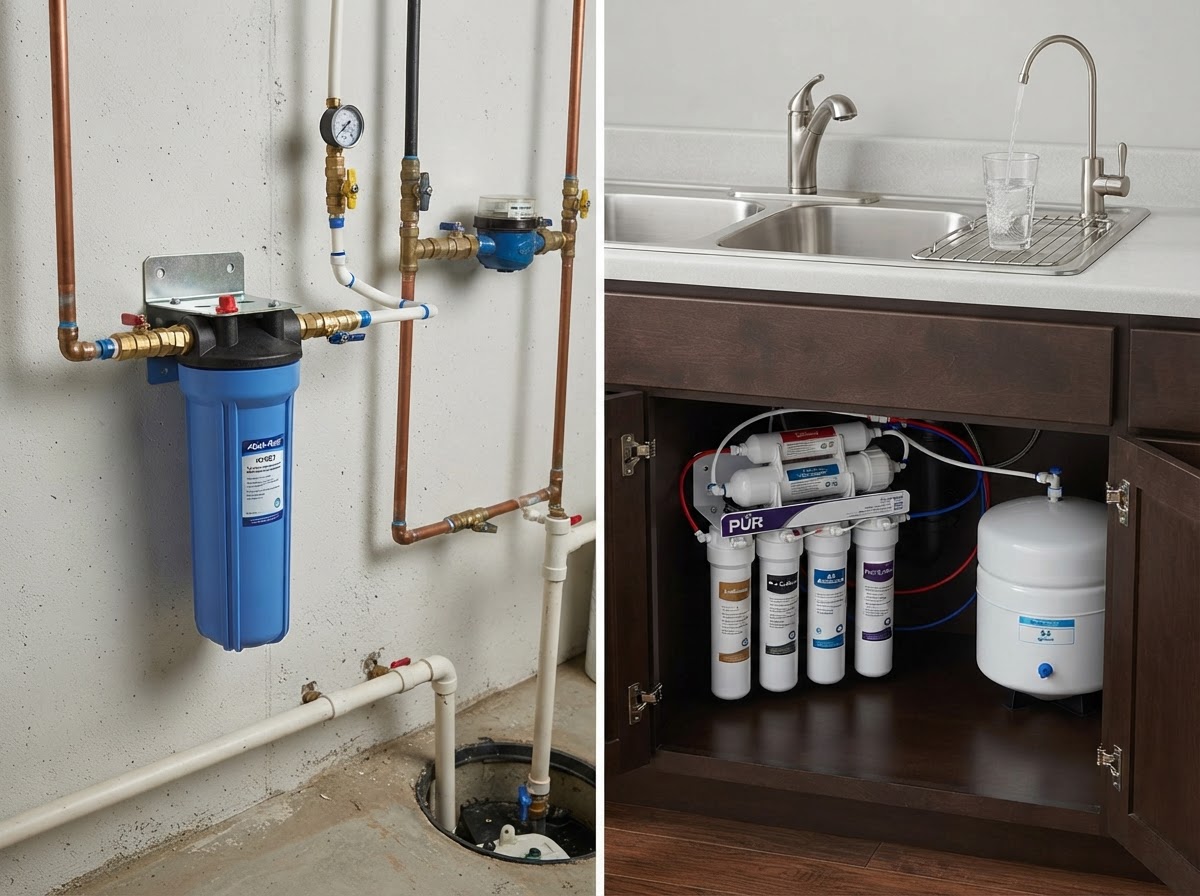
Water Filtration Options for Lincoln Homes
Different systems are designed for different water treatment goals. Some filters provide drinking water treatment at one faucet, while others are installed near the incoming main water line and serve multiple fixtures. Equipment selection should be based on water information, verified product capabilities, plumbing, and maintenance needs.
Whole-House Water Filtration
Whole-house systems generally treat incoming water before it reaches multiple household fixtures. They may be appropriate for specified sediment, taste and odor, or other treatment goals when supported by the particular equipment's performance claims.
Explore whole-house filtrationUnder-Sink Water Filtration
Under-sink systems focus on drinking and cooking water at one faucet. These systems may be worth considering when the main goal is point-of-use treatment rather than filtration throughout the home.
Explore under-sink filtrationReverse Osmosis Systems
Reverse osmosis uses a semipermeable membrane with other treatment stages. Certain RO systems have certified claims for reducing specified substances, including particular PFAS compounds.
Explore reverse osmosis systemsPFAS Water Filtration
Some carbon, reverse osmosis, and specialized treatment systems are designed to reduce certain PFAS compounds. Choose equipment using verified, product-specific reduction claims.
Explore PFAS filtrationWater Testing
Appropriate laboratory testing may help answer specific questions about a property's water or the performance of existing treatment equipment. Municipal reports and property-specific samples answer different questions.
Explore water testingFilter Replacement and Repair
Existing systems may require new cartridges, membranes, treatment media, or equipment repairs. A frequently clogged filter may need further evaluation rather than simply another replacement.
Explore filter replacementWhere Does Lincoln Get Its Drinking Water?
Unlike neighboring towns such as Weston and Lexington, Lincoln operates its own municipal drinking water system rather than relying on MWRA as its current main supply. According to Lincoln Water Department's 2025 Consumer Confidence Report, its municipal drinking water comes from two sources.
Flint's Pond is the primary municipal water source. It is a surface-water source located in the north-central part of Lincoln, and water from Flint's Pond is treated at the town's microfiltration plant. Tower Road Well is a groundwater source that the town describes as a supplemental source used daily to provide additional supply and system resilience.
Water from the two sources can be blended within Lincoln's distribution system. The 2025 report describes approximately 62 miles of water mains, a 1.2-million-gallon storage tank on Bedford Road, and approximately 497 fire hydrants. These are figures from the report, not live infrastructure counts.
How Does Lincoln Treat Its Drinking Water?
Lincoln treats municipal drinking water before it reaches customers. The town's treatment process includes microfiltration for the Flint's Pond surface-water supply. Microfiltration uses membrane-based separation to remove certain suspended material and microorganisms within the system's rated treatment capabilities.
Lincoln's report also describes coagulation, disinfection with chlorine, and water chemistry adjustment for corrosion control. Fluoride treatment is included in the town's reported water treatment program. Treatment requirements and processes may differ depending on the water source and operating conditions.
Lincoln's process is not identical to MWRA's treatment program. In particular, Lincoln should not be described as using MWRA's monochloramine system. A homeowner considering a filter should look at Lincoln's actual treatment and the specific property concern. Home filtration is not required simply because the town uses pond or well water.
What Does Lincoln's PFAS Water Testing Show?
PFAS are a group of manufactured chemicals that have been used in various industrial and consumer applications. Some PFAS are persistent in the environment and can enter drinking water sources. Lincoln Water Department monitors PFAS and publishes testing information.
Flint's Pond (2025)
No detectable PFAS reported during 2025 testing. Non-detect depends on laboratory reporting limits and is not proof of an absolute zero concentration.
Tower Road Well (2025)
PFAS reported at 9.42 to 14.5 parts per trillion. The town stated this was below the Massachusetts PFAS6 limit of 20 ppt for the combined six specified compounds.
Distribution blending
Well water is blended with surface water in the distribution system, so source-well results are not the concentration at every household faucet.
Lincoln reports that water from Tower Road Well is blended with water from its surface-water source in the distribution system. Therefore, the source-well measurements should not be presented as the concentration at every household faucet.
Regulatory note: Massachusetts' PFAS6 standard and individual federal PFAS limits are different measures. The 2025 report's finding that Tower Road Well was below the Massachusetts PFAS6 limit does not automatically establish compliance with every separate federal compound-specific limit. Lincoln's 2025 Annual Town Report discusses additional monitoring related to the newer federal PFAS framework. Any discussion of federal compliance must reflect verified current regulations, actual measurements for individual compounds, applicable averaging procedures, and implementation requirements.
These results do not mean Lincoln's municipal water is unsafe, and there is no current PFAS emergency. Source-well measurements are not the same as finished-water measurements at every home. Do not equate the two.
What Water Filters Can Reduce PFAS?
Certain residential filtration technologies can reduce specified PFAS compounds. Actual performance depends on the contaminants and exact equipment. Customers must check the exact product model and its current certified PFAS claims.
Activated Carbon Filtration
Certain activated carbon systems can reduce selected PFAS compounds through adsorption. Performance depends on filter design, contact time, water conditions, capacity, and the particular PFAS involved. Not every carbon filter is certified for PFAS reduction.
Reverse Osmosis Systems
Certain reverse osmosis systems have independently verified reduction claims for PFOA, PFOS, or other specified PFAS compounds. RO commonly treats drinking water at a kitchen sink. Membranes and other components require maintenance.
Specialized Ion-Exchange Systems
Certain specialized anion-exchange resins are used for PFAS reduction. These are not the same as ordinary residential cation-exchange softeners that reduce calcium and magnesium.
NSF/ANSI 53 and NSF/ANSI 58 may be relevant to PFAS reduction claims, but certification under one of those standards for another purpose does not prove PFAS reduction. A product certified for one contaminant should not be assumed to reduce every other contaminant. Do not promise complete or permanent removal of all PFAS compounds.
Under-Sink or Whole-House Water Filtration for Lincoln?
A concern focused on PFAS in drinking water does not automatically require whole-house equipment. Whether point-of-use or whole-house treatment is appropriate depends on actual water results, treatment objectives, system performance, household plumbing, and cost. A larger filter is not automatically more effective.
Under-Sink Filtration
- Usually serves one drinking water faucet.
- May be practical when the primary treatment objective involves water used for drinking and cooking.
- Certain certified carbon or reverse osmosis systems may offer verified reductions for particular substances.
Whole-House Filtration
- Generally treats water before it reaches multiple household fixtures.
- May be appropriate for a defined treatment goal involving multiple points of use.
- Requires larger capacity, appropriate flow rates, and sometimes specialized maintenance.
Should You Test Your Lincoln Home's Water?
Lincoln Water Department publishes monitoring for its municipal system. For residents connected to that supply, the town's most recent Consumer Confidence Report is an important first source of information. However, conditions at a particular home may also depend on plumbing, fixtures, and existing treatment equipment.
Property-specific testing may be appropriate when:
- A homeowner has a specific contaminant concern.
- A property uses a private well.
- The water source is uncertain.
- A particular plumbing component raises questions.
- A filtration system's performance needs evaluation.
- Unexpected taste, odor, or visible particles require investigation.
PFAS analysis requires appropriate laboratory methods. A basic TDS meter does not detect or quantify PFAS. Lead testing also requires suitable methods. Testing should match the actual concern. For private well owners, additional water-quality parameters may be appropriate based on the source and local conditions. Not every homeowner needs comprehensive laboratory testing.
Waltham Water Filtration Co. does not operate its own laboratory. We help homeowners connect with independent water treatment providers and discuss testing considerations.
What If Your Lincoln Property Uses a Private Well?
Lincoln includes a mix of residential properties in wooded and conservation-oriented settings. Some properties may have water sources that differ from the municipal system. Do not assume every Lincoln property uses a private well.
For a private water source, the owner's testing and treatment needs may differ from the Lincoln Water Department's published municipal results. A treatment system should be selected only after relevant water conditions are established.
Potential testing topics may include:
- Hardness
- pH
- Bacteria
- Iron or manganese when relevant
- PFAS when supported by property history or local recommendations
- Other source-specific substances as appropriate
These are possible testing categories, not claims that Lincoln private wells have elevated levels of any particular contaminant. A sediment filter does not address every dissolved substance or microorganism, and a water softener is not a universal contaminant removal system. Do not prescribe specific equipment without relevant testing or evidence.
Does Lincoln Have Hard Water?
Lincoln's municipal water comes from its own surface-water and groundwater sources. Do not assume Lincoln's water has the same hardness as MWRA-supplied communities. The MWRA hardness figure of approximately 1 grain per gallon must not be used as Lincoln's municipal hardness value.
Water hardness measures dissolved calcium and magnesium. A water softener may be appropriate when testing confirms a hardness-related treatment goal. But homeowners should not install a softener solely because their property is located in Lincoln. Actual water hardness can vary depending on source and household conditions, and testing may help determine whether softening is useful.
A conventional softener primarily reduces calcium and magnesium. It is not automatically certified to reduce PFAS, lead, or other drinking water contaminants. We do not invent a Lincoln hardness measurement.
Local Water System Improvements and Future Planning
The town maintains local pipes, storage, water treatment, and distribution equipment. Its 2025 Consumer Confidence Report describes work involving the Lincoln Road water main replacement project, including construction scheduled in phases.
The town's annual report also discusses evaluating a possible future connection to MWRA. The proposed MWRA interconnection is a long-term strategic option involving feasibility, cost, and infrastructure considerations. It is not evidence that Lincoln currently receives MWRA water as its normal municipal supply.
Future water-source decisions may affect long-term system planning, but the homeowner should use the current Lincoln Water Department reports when making treatment decisions. Do not promise the connection will happen, and do not invent a completion date.
Water Filtration Installation for Lincoln Homes
Lincoln includes established homes, rural-style properties, wooded lots, historic buildings, and newer residential construction. Different property layouts can affect installation. Building age or architectural style alone does not establish a contaminant problem.
Under-Sink Filtration
Requires adequate kitchen cabinet space, suitable supply connections, and access for maintenance.
Reverse Osmosis Systems
Some systems require a drinking water faucet, drain connection, and tank or tankless components.
Whole-House Equipment
May require main-line access, sufficient installation space, appropriate bypass plumbing, and sizing for household demand.
Private Water Systems
Homes using private supplies may have additional pumps, pressure tanks, or source-specific treatment components. Do not assume all private systems are identical.
Higher Household Flow
Homes with multiple bathrooms may require attention to equipment capacity if whole-house filtration is appropriate.
Maintenance Access
Filter and membrane replacement should be considered before installation. Plumbing modifications must comply with Massachusetts requirements and manufacturer instructions.
Not every system can be installed in every Lincoln property. The right approach depends on the home, the equipment, and the treatment goal. We do not provide detailed DIY plumbing modification instructions.
Water Filter Replacement and Repair in Lincoln
Existing filtration equipment requires maintenance. Common concerns fall into a few categories, and they call for different responses.
Cartridges Reaching Capacity
Cartridges and sediment filters can reach their rated service life and become restrictive as they capture particles.
Reduced Flow
Reduced water flow may involve a clogged cartridge, a fitting, or another component.
Leaking Housings
A leaking filter housing or fitting may need inspection or appropriate repair.
Reverse Osmosis Service
RO membranes or prefilters may require service when the system produces less water than expected.
Filters No Longer Appropriate
A filter may no longer match the household's treatment goal, or incompatible replacement components may have been installed.
Valve or Fitting Problems
Equipment problems involving valves or fittings may require repair rather than a simple cartridge change.
For certified contaminant-reduction filters, proper replacement components and maintenance are essential. A system may continue passing water after its intended treatment capacity has been exhausted. Normal water taste does not prove a filter still reduces PFAS or another specified contaminant. A clogged filter does not automatically mean the public water supply is unsafe. For frequent clogging, the source of particles, system size, and cartridge characteristics may need evaluation.
Water Filtration Options Across Lincoln
Lincoln combines residential neighborhoods, wooded roads, conservation land, and historic properties. A home near Lincoln Station may have different installation space than a larger property along South Great Road or Bedford Road.
Lincoln's landscape includes Flint's Pond and a local groundwater supply, both of which are relevant to the town's municipal water system. The appropriate filtration equipment depends on a property's actual water source, treatment goal, plumbing, and maintenance requirements — not simply its neighborhood.
Landmarks are included for local reference only. They do not imply the company performed work at these locations, that properties near Flint's Pond necessarily have elevated PFAS, that homes near Tower Road Well receive exactly the reported source-well concentration, that specific neighborhoods have unsafe water, or that all wooded properties rely on private wells.
How Much Does Water Filtration Installation Cost in Lincoln?
Costs depend on the filtration technology, equipment capacity, and installation requirements. A certified under-sink drinking water filter and a whole-house specialty treatment system may have very different costs. A property with a private well may also have equipment considerations that differ from a municipal-water connection.
Customers should compare total ownership costs and maintenance obligations. We do not invent Lincoln-specific prices, and we do not promise free testing or guaranteed pricing.
Getting Help With Water Filtration in Lincoln
- 1
Call About Your Water Goals
Tell us whether your home uses municipal or private water, what filtration equipment you have, and what you're hoping to address.
- 2
Discuss Available Options
Waltham Water Filtration Co. helps connect Lincoln homeowners with independent water treatment providers who can discuss filtration and service options.
- 3
Review Equipment and Pricing
Discuss verified treatment capabilities, installation requirements, maintenance, and available pricing before deciding how to proceed.
Waltham Water Filtration Co. does not directly test water or dispatch employed technicians. We help homeowners connect with independent water treatment providers serving the area.
Explore Water Filtration Services
PFAS Water Filtration
Treatment technologies with specified PFAS-reduction claims.
Learn moreReverse Osmosis Systems
Point-of-use membrane filtration for drinking water.
Learn moreUnder-Sink Water Filtration
Kitchen drinking water treatment options.
Learn moreWhole-House Water Filtration
Treatment options for water serving multiple fixtures.
Learn moreWater Testing
Appropriate testing for specific water questions.
Learn moreWater Filtration Installation
Plumbing, equipment sizing, and setup considerations.
Learn moreWater Filter Replacement
Routine maintenance and compatible cartridge replacement.
Learn moreWater Filtration Repair
Leaks, reduced flow, and equipment problems.
Learn moreWater Filtration FAQs for Lincoln, MA
Straight answers about Lincoln's own water system, PFAS monitoring, filtration options, and installation.
Where does Lincoln, MA get its drinking water?+
Lincoln operates its own municipal water system. According to its 2025 Consumer Confidence Report, the town uses Flint's Pond as its primary surface-water source and Tower Road Well as a supplemental groundwater source. Water from these sources is treated and distributed through Lincoln's local system. Lincoln should not be confused with nearby communities receiving MWRA municipal water.
Does Lincoln receive drinking water from MWRA?+
Lincoln currently operates its own municipal supply using Flint's Pond and Tower Road Well. Its 2025 annual report discusses evaluating a possible future MWRA connection, but this is a long-term planning option, not confirmation that Lincoln currently receives MWRA water as its primary municipal source.
Did Lincoln detect PFAS in its drinking water sources?+
Lincoln's 2025 report says no PFAS were detected at Flint's Pond during the year's reported testing. At Tower Road Well, the town reported PFAS measurements from 9.42 to 14.5 parts per trillion. The town stated these source results were below Massachusetts' 20 ppt PFAS6 standard for the reporting period. Well water is blended with surface water in the distribution system, so these are not measurements at every home.
Does Lincoln's PFAS result mean I need a water filter?+
Not automatically. Whether filtration is appropriate depends on current municipal reports, any property-specific testing, the exact PFAS compounds involved, treatment goals, and the equipment's verified performance. A result below Massachusetts' reported PFAS6 limit should not be confused with compliance under every separate federal compound-specific standard. Call to discuss available PFAS filtration options.
What kind of water filter can reduce PFAS?+
Certain activated carbon, reverse osmosis, and specialized anion-exchange systems can reduce specified PFAS compounds. The exact product must carry appropriate verified reduction claims. Not every carbon filter or reverse osmosis system is certified for PFAS reduction. Filter replacement and maintenance are also important to performance.
Is under-sink or whole-house filtration better for Lincoln homes?+
Neither is automatically better. Under-sink filtration treats drinking and cooking water at a particular faucet, while whole-house equipment treats water serving multiple fixtures. For some drinking water goals, a certified point-of-use filter may be practical. Whole-house treatment requires additional flow and maintenance considerations. The right choice depends on the actual treatment objective.
Does Lincoln have hard water?+
Lincoln uses local surface-water and groundwater sources, so MWRA hardness figures from neighboring towns should not be applied to Lincoln. Water hardness should be evaluated using Lincoln-specific information or appropriate property testing. A conventional softener may be useful for a verified hardness concern, but is not automatically needed for every home.
Should I test my Lincoln home's water?+
Reviewing Lincoln Water Department's current Consumer Confidence Report is a useful first step for municipal customers. Property-specific testing may be appropriate for particular contaminant concerns, private wells, or questions about household plumbing. PFAS and lead require appropriate testing methods. A basic TDS meter does not measure those substances.
Can a water filter remove lead and PFAS at the same time?+
Some filtration systems have verified reduction claims for more than one substance, but this depends on the exact model and certification. A product certified for one contaminant should not be assumed to reduce every other contaminant. Review the manufacturer's performance data and approved replacement components.
How much does water filtration installation cost in Lincoln?+
Costs vary according to filtration technology, treatment goals, equipment capacity, plumbing, water source, installation requirements, and ongoing filter replacement. Under-sink reverse osmosis and whole-house treatment may involve different costs. Call (781) 226-3613 to discuss available filtration options and pricing.
Water Filtration in Nearby Communities
Weston, MA
South of Lincoln, Weston receives MWRA municipal water and has its own service-line inventory.
View town pageLexington, MA
East of Lincoln, Lexington receives MWRA water and runs a phased lead service-line replacement project.
View town pageWeston and Lexington receive MWRA municipal water, while Lincoln operates its own municipal system. Their water-quality results do not apply to Lincoln. Waltham Water Filtration Co. helps homeowners explore filtration options in Lincoln and nearby communities and does not maintain physical offices in each town.
Explore Water Filtration Options for Your Lincoln Home
Whether you're comparing reverse osmosis systems, considering a whole-house filter, or reviewing information about Lincoln's local drinking water sources, choosing the right treatment equipment starts with accurate information. Lincoln's municipal supply is different from neighboring MWRA-served towns, and the town's published water monitoring provides useful context for homeowners considering filtration. Waltham Water Filtration Co. helps Lincoln homeowners explore water treatment, installation, testing considerations, and maintenance options while connecting customers with independent providers serving the area. Call to discuss your water concerns and available next steps.