Water Filtration in Belmont, MA
Considering a water filtration system for your Belmont home? Whether you're comparing whole-house filtration, an under-sink drinking water filter, or reverse osmosis equipment, the best choice depends on what you want to treat and how your home's plumbing is arranged.
Belmont receives treated drinking water from MWRA, while individual homes may have different fixtures, plumbing materials, and treatment preferences. Waltham Water Filtration Co. helps Belmont homeowners explore filtration systems, installation, maintenance, and testing options while connecting customers with independent water treatment providers serving the area. Call to discuss available options for your home.
- Whole-House Water Filtration
- Under-Sink Drinking Water Filters
- Reverse Osmosis Systems
- Water Filter Replacement & Repair
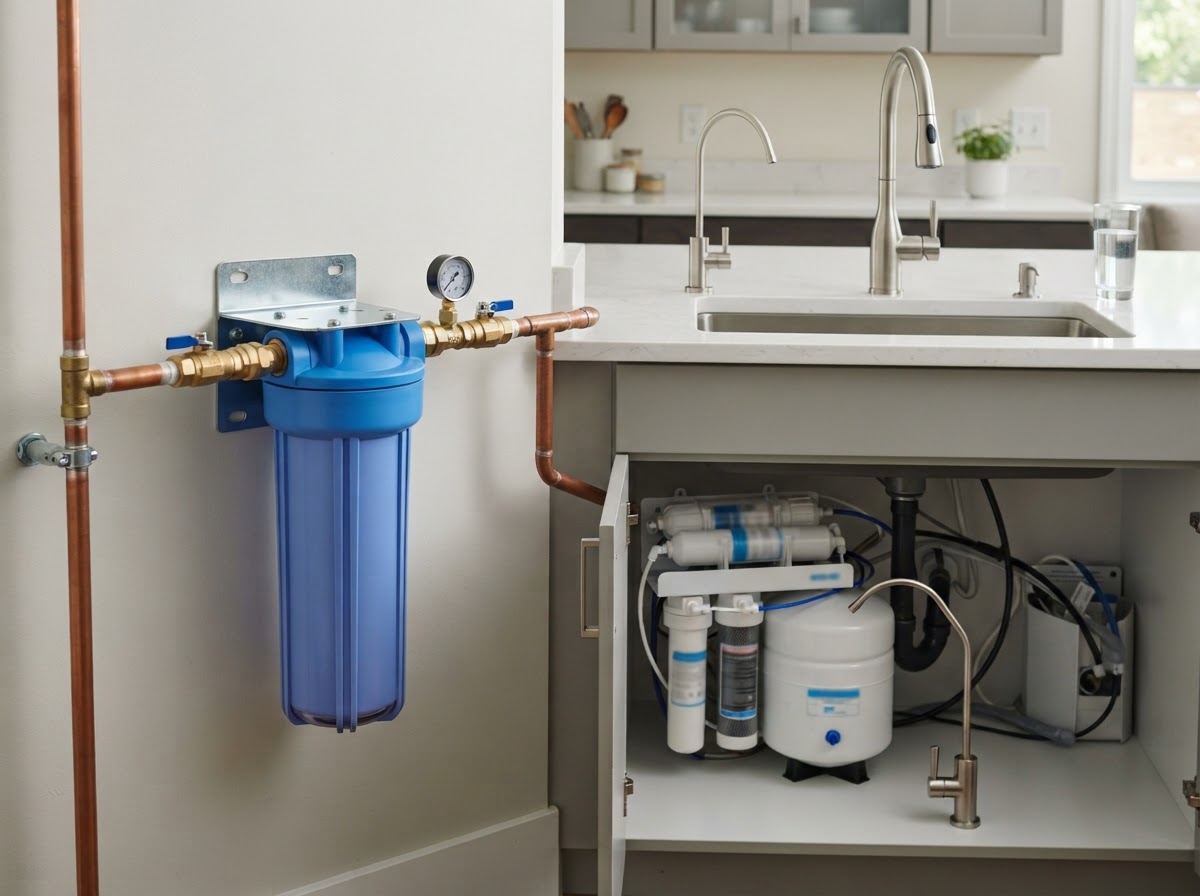
Water Filtration Options for Belmont Homes
Water filtration systems are designed for different treatment goals. Some provide water at a single drinking water faucet, while others treat incoming water serving multiple household fixtures. Choosing the right equipment means considering water conditions, intended reduction claims, flow requirements, installation space, and maintenance.
Whole-House Water Filtration
Whole-house systems are generally installed near the incoming main water line. Depending on the model, they may be used for sediment, particular taste and odor goals, or other substances supported by verified treatment claims. System capacity should match household water demand.
Explore whole-house filtrationUnder-Sink Water Filtration
Under-sink filtration focuses on water used at a kitchen faucet. It may be practical for households primarily concerned with drinking and cooking water rather than water used at every fixture.
Explore under-sink filtrationReverse Osmosis Systems
Reverse osmosis uses membrane filtration and other stages to treat drinking water. Certified reduction claims and maintenance needs vary by product, so the exact model and installation matter.
Explore reverse osmosis systemsWater Filtration Installation
Installation depends on water line access, cabinet or utility space, equipment requirements, and household plumbing. Different systems have different installation requirements.
Explore installation optionsWater Testing
Appropriate water testing may help investigate a specific concern or establish whether a particular treatment system is suitable. Municipal water-quality reports are not substitutes for testing every individual household faucet.
Explore water testingFilter Replacement and Repairs
Existing equipment may need compatible cartridges, new seals, component repairs, or other service. A frequently clogged filter may need further evaluation rather than simply another replacement.
Explore filter replacementWhere Does Belmont Get Its Drinking Water?
Belmont purchases its entire municipal drinking water supply from the Massachusetts Water Resources Authority, commonly known as MWRA. MWRA's source water comes from the Quabbin and Wachusett reservoir system. Water is treated before entering regional transmission infrastructure and Belmont's local distribution network.
Belmont Water Division maintains the town's local distribution system. According to the town's 2025 drinking water report, Belmont maintains approximately 90.1 miles of water mains, 879 fire hydrants, 2,886 gate valves, and 7,395 water service connections. The report also describes a long-running water main replacement program intended to modernize aging infrastructure.
These numbers are from the published report and should not be presented as live or continuously updated counts. Municipal treatment and household plumbing are separate considerations: the public water supply is monitored, but conditions at an individual home's faucet can also depend on plumbing components and fixtures.
What Should Belmont Homeowners Know About Lead Service Lines?
Belmont completed its initial water service-line inventory in October 2024. That inventory identified four homes with lead service lines. The same inventory reported no unknown-material service lines and no galvanized-requiring-replacement service lines.
The town notified the affected property owners and described plans to replace those lead lines with copper tubing at no charge to those owners. Belmont's current public lead-information page now states that one lead service line remains and that the town is working with the homeowner toward replacement. This is a meaningful update from the original four-line inventory.
A water service-line inventory also does not prove that every interior fixture or piece of solder is free from lead. Lead can enter water through certain household fixtures or plumbing components. For residents with property-specific concerns, the town's service-line information and appropriate tap-water testing can provide additional context. Some point-of-use drinking water filters have independently certified lead-reduction claims, but the exact product must be verified.
What Does Belmont's Lead Water Testing Show?
According to Belmont's 2025 water-quality report, the community's regulatory monitoring showed a 90th-percentile lead concentration of 1.5 parts per billion, with none of 20 samples above the report's 15 ppb lead action level. The report listed a 90th-percentile copper concentration of 67.7 parts per billion against a copper action level of 1,300 ppb, with none of 20 samples above that level.
These are regulatory monitoring results from selected sampling locations. They are not measurements at every faucet in Belmont, and a low community-level 90th-percentile reading does not establish that all individual plumbing materials are lead-free. Lead can enter water through certain household fixtures or plumbing components.
EPA's health-based maximum contaminant level goal for lead is zero, so the regulatory action level should not be read as a universal safe-exposure threshold. Homeowners with specific concerns may consider appropriate water testing. The reporting period for these figures is 2025.
Drinking Water Filters for Lead Concerns
When the goal is reducing lead in drinking and cooking water, a properly selected point-of-use filter may be an appropriate option. EPA recommends selecting filters with verified reduction claims. Relevant considerations include:
NSF/ANSI 53
Look for an explicit lead-reduction certification for the exact filter model. Certification to the standard for some other contaminant is not sufficient evidence of lead reduction.
NSF/ANSI 42
EPA also recommends Class I particulate reduction for small particles that may contain lead.
Certified Reverse Osmosis Systems
Certain reverse osmosis systems carry verified lead-reduction claims. Do not assume all reverse osmosis equipment has identical certifications.
Approved Replacement Cartridges
A filter's performance depends on the actual components and proper maintenance. Use the manufacturer's specified replacement cartridges.
Certified filtration can reduce lead within the product's verified conditions, but it does not remove the physical source of lead from plumbing. A whole-house filter installed before interior plumbing may not address lead entering through downstream fixtures.
Which Water Filtration System Is Right for a Belmont Home?
Whole-House Filtration
- Treats incoming water before it reaches multiple household fixtures.
- May be appropriate for a defined treatment need affecting much of the home.
- Requires sizing for water demand, pressure, and long-term maintenance.
Under-Sink Filtration
- Treats drinking water at a particular faucet.
- May be more practical when the treatment goal concerns drinking and cooking water.
- Generally involves more compact equipment.
The correct choice depends on
- Treatment goals.
- Location where treatment is needed.
- Product certification.
- Plumbing configuration.
- Available space.
- Maintenance.
- Cost.
A larger system is not automatically more effective. For lead related to downstream plumbing or fixtures, point-of-use filtration may be particularly relevant. Not every Belmont home requires either system.
Does Belmont Have Hard Water?
Belmont receives MWRA municipal water, which is naturally soft. MWRA reports typical hardness around 16 mg/L as calcium carbonate, or approximately 1 grain per gallon. Many Belmont homes on the municipal water supply do not need a conventional water softener.
Water hardness is not the same thing as general drinking water quality. Conventional softeners mainly reduce calcium and magnesium. Water filtration equipment may address different goals, such as sediment or specified taste, odor, and contaminant-reduction claims.
MWRA also uses monochloramine for ongoing disinfection within its distribution system. Not every carbon filter has verified chloramine-reduction capability. Any filter intended for that goal should have appropriate product-specific claims.
Water Filtration Installation for Different Belmont Homes
Belmont has a mix of older homes, renovated properties, multifamily buildings, and larger single-family houses. Plumbing layouts and available installation space may vary, so different properties can have different installation requirements.
Village-Center Properties
Some properties near Belmont Center, Cushing Square, or Waverley Square may have compact utility spaces or kitchen configurations. Building age alone does not prove a home contains lead plumbing.
Single-Family Homes
Whole-house equipment may require main water line access and sufficient capacity for the home's flow requirements.
Under-Sink Systems
Cabinet space, plumbing connections, and maintenance access should be considered when planning a point-of-use system.
Reverse Osmosis
Some RO systems need a dedicated faucet, drain connection, and tank or tankless components.
Existing Equipment
A replacement system must be compatible with the actual plumbing and treatment goal.
Regulatory Requirements
Plumbing modifications should follow applicable Massachusetts requirements and manufacturer instructions.
Not every system can be installed in every Belmont property. The right approach depends on the home, the equipment, and the treatment goal. Call to discuss your home, equipment, and available options.
Should You Test Your Belmont Home's Drinking Water?
The appropriate first step depends on the homeowner's concern. For Belmont residents receiving municipal water, reviewing the current MWRA and Belmont water-quality information provides important background. Property-specific testing may be useful when a homeowner wants to investigate a concern at an individual property.
Property-specific testing may be useful when investigating:
- Lead at a particular faucet.
- An unusual water appearance.
- Unknown private or alternative water sources.
- Specific contaminant concerns.
- Questions involving existing treatment equipment.
A TDS meter cannot reliably measure lead or PFAS. Water color, taste, or odor alone cannot establish whether specific contaminants are present. Laboratory testing should use suitable methods and sampling procedures. Not every filtration purchase requires comprehensive laboratory analysis, and we do not operate a laboratory ourselves.
Water Filter Replacement and Repair in Belmont
Existing filtration systems need maintenance. Common situations fall into a few categories, and they call for different responses.
Restricted Sediment Cartridges
A sediment filter may become restrictive as it captures particles. Rapid clogging can have multiple causes.
Under-Sink Cartridges Past Capacity
Under-sink cartridges reaching rated capacity may need routine replacement.
Reduced Drinking Water Flow
Reduced flow may involve a clogged cartridge, a fitting, or another component.
Leaking Filter Housings or Connections
Leaking filter housings or connections may need inspection or appropriate repair.
Reverse Osmosis Producing Too Little Water
Low RO production may involve prefilters, membranes, pressure, or tank components.
Incompatible Replacement Cartridges
Incompatible cartridges or older equipment that no longer meets the household's goals may need evaluation.
Maintenance, repair, and replacement are different options. A clogged cartridge may simply need changing. A damaged housing or malfunctioning valve may require repair. An undersized system may need evaluation before replacement. Normal taste or water flow does not prove a filter still meets every contaminant-reduction claim.
Water Filtration Options Across Belmont
Belmont includes busy village centers, quieter residential streets, multifamily properties, and larger single-family homes. Homes in different parts of town may have different plumbing layouts, available installation space, and existing water treatment equipment.
A homeowner near Waverley Square may be comparing a compact under-sink filter, while someone with a larger home near Belmont Hill may be considering equipment serving several fixtures. From Belmont Center toward Cushing Square and along Trapelo Road, the appropriate filtration setup depends on the water concern and plumbing layout rather than neighborhood name alone. These are examples of different household needs, not claims about specific properties.
Area and street names are included for local reference only. They do not imply neighborhood-specific water contamination, and a location alone does not establish a home's water quality, plumbing materials, or contaminant levels.
How Much Does Water Filtration Installation Cost in Belmont?
Pricing depends on the filtration system, treatment goal, equipment capacity, plumbing configuration, installation work, and maintenance requirements. An under-sink drinking water filter may require different equipment and plumbing work from a whole-house treatment system.
Customers should compare initial costs and ongoing ownership expenses. We do not publish fixed local prices or promise free water testing, diagnostics, or installation. Call to discuss your goals and available options.
Getting Help With Water Filtration in Belmont
- 1
Call About Your Water Goals
Tell us whether you're interested in installing a new filter, replacing an existing system, or exploring a specific water concern.
- 2
Discuss Available Options
Waltham Water Filtration Co. helps connect Belmont homeowners with independent water treatment providers who can discuss relevant systems and services.
- 3
Review Equipment and Pricing
Discuss treatment goals, product capabilities, installation requirements, and available pricing before deciding how to proceed.
Waltham Water Filtration Co. does not directly send its own employees to perform installation or operate a laboratory. We help homeowners connect with independent water treatment providers serving the area.
Explore Water Filtration Services
Lead Water Filtration
Systems with verified lead-reduction claims.
Learn moreUnder-Sink Water Filtration
Point-of-use treatment for drinking and cooking water.
Learn moreReverse Osmosis Systems
Membrane-based drinking water treatment options.
Learn moreWhole-House Water Filtration
Filtration serving multiple household fixtures.
Learn moreWater Testing
Appropriate testing for specified water concerns.
Learn moreWater Filter Replacement
Cartridge changes and ongoing maintenance.
Learn moreWater Filtration Repair
Leaks, reduced flow, and equipment problems.
Learn moreWater Filtration FAQs for Belmont, MA
Straight answers about Belmont's water supply, lead service lines, filtration options, and installation.
Where does Belmont, MA get its drinking water?+
Belmont purchases its municipal drinking water from MWRA. The water originates from the Quabbin and Wachusett reservoir system and is treated before reaching Belmont's distribution network. Belmont Water Division maintains the local infrastructure and publishes water-quality information.
Does Belmont have lead water service lines?+
Belmont's October 2024 inventory identified four homes with lead service lines. The town's subsequently updated public information says one lead service line remains, with replacement efforts continuing. This does not mean all Belmont homes have lead plumbing. Residents can check the town's official service-line inventory and contact the Water Division with property-specific questions.
What were Belmont's 2025 lead testing results?+
Belmont reported a 90th-percentile lead result of 1.5 parts per billion in 2025, with none of 20 samples exceeding the 15 ppb action level listed for that monitoring period. These are selected regulatory sampling results, not measurements at every household faucet. Appropriate property-specific testing may be useful when there is a particular concern.
What type of drinking water filter can reduce lead?+
Certain point-of-use filters are certified to reduce lead. Check the exact model for an NSF/ANSI 53 lead-reduction claim and review EPA guidance about Class I particulate reduction under NSF/ANSI 42. Not every carbon filter or reverse osmosis system has the same verified claims. Call to compare filtration options.
Does Belmont have hard water?+
Belmont receives naturally soft MWRA water, typically around 16 mg/L or approximately 1 grain per gallon. Many municipal-water customers do not need conventional water softeners. Properties with another water source or particular treatment needs may warrant separate testing.
Should I install a whole-house or under-sink filter?+
Whole-house filtration treats water serving multiple fixtures. Under-sink filtration targets a particular drinking water outlet. The best option depends on the treatment goal, the location of the concern, certified product performance, installation needs, and maintenance costs. A whole-house system is not automatically necessary for drinking water concerns.
Why is my existing water filter clogging so quickly?+
Rapid clogging may involve particle loading, cartridge micron rating, equipment capacity, household water use, or plumbing conditions. A dirty cartridge does not automatically prove Belmont's municipal water is unsafe. Evaluating the filtration setup and possible causes may help determine an appropriate next step.
How much does water filtration installation cost in Belmont?+
Pricing depends on the type of equipment, treatment goal, plumbing, installation requirements, and maintenance needs. Under-sink filters, reverse osmosis systems, and whole-house filtration can involve different costs. Call (781) 226-3613 to discuss available systems and pricing.
Water Filtration in Nearby Communities
Watertown, MA
East of Belmont, Watertown has dense residential neighborhoods with varied housing stock.
View town pageLexington, MA
Northwest of Belmont, Lexington features many single-family homes with mature plumbing in places.
View town pageWaltham Water Filtration Co. helps homeowners explore filtration options across Belmont and nearby Massachusetts communities. Neighboring-town pages describe their own local conditions and do not imply separate physical offices in each town. Belmont's lead service-line inventory does not apply to Watertown, Lexington, or Waltham.
Explore Water Filtration Options for Your Belmont Home
Whether you're comparing under-sink filters, considering whole-house filtration, or looking into a specific drinking water concern, the right solution should match your treatment goals and your home's plumbing. Belmont's municipal water reports and service-line information provide useful community context, while individual properties may have different filtration or maintenance needs. Waltham Water Filtration Co. helps Belmont homeowners explore water treatment options and connect with independent providers serving the area. Call to discuss equipment, installation requirements, maintenance, and available pricing.