Water Filtration in Watertown, MA
Looking for water filtration options for your Watertown home? Whether you're interested in a whole-house water filter, an under-sink drinking water system, or reverse osmosis, choosing the right equipment starts with understanding your water treatment goals and your home's plumbing.
Watertown receives treated drinking water from MWRA, but individual plumbing materials, fixtures, and existing filtration equipment can still affect what homeowners want to investigate. Waltham Water Filtration Co. helps Watertown homeowners explore filtration, installation, maintenance, and testing options while connecting customers with independent water treatment providers serving the area. Call to discuss available options for your home.
- Whole-House Filtration
- Under-Sink Drinking Water Filters
- Reverse Osmosis Systems
- Filter Replacement & Maintenance
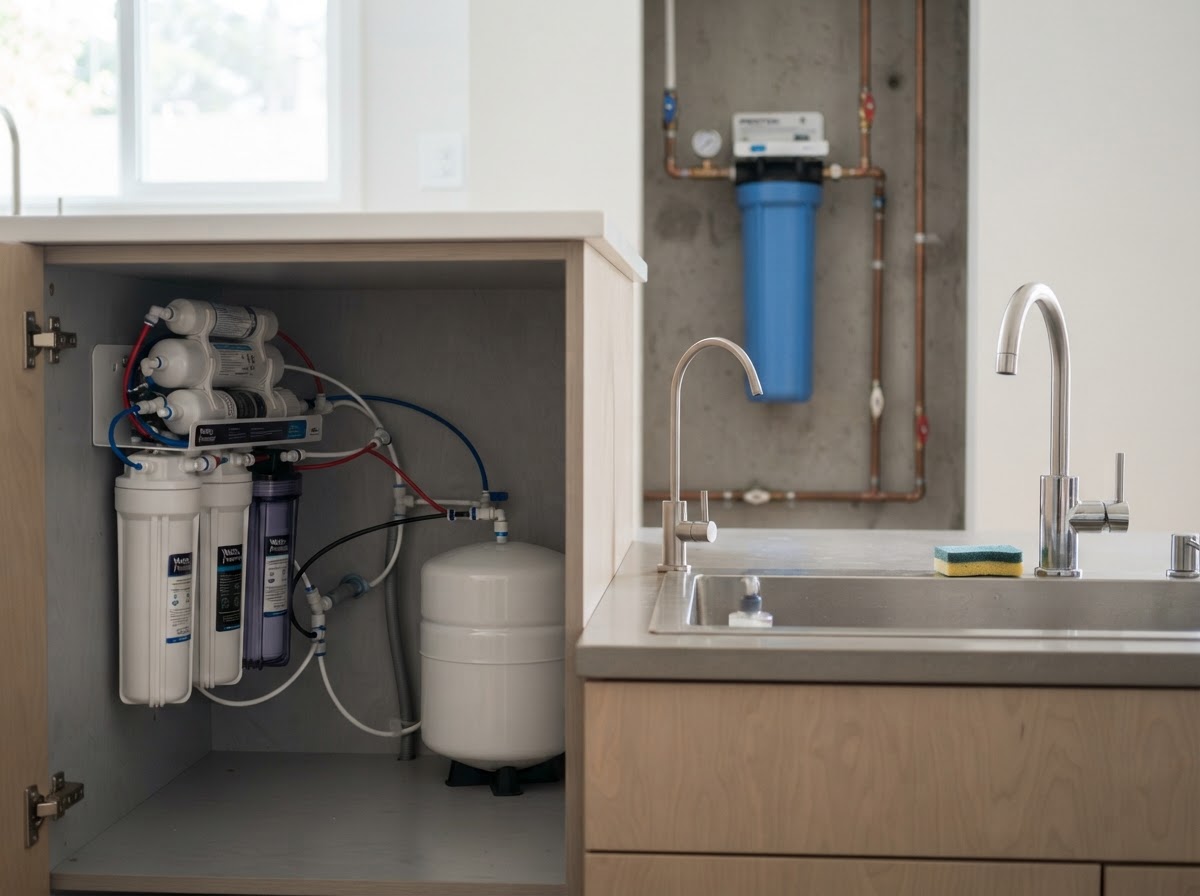
Residential Water Filtration Options in Watertown
Different water filtration systems serve different purposes. Some treat drinking water at one faucet, while others are installed near the incoming water supply. The right system depends on the substances being targeted, flow requirements, plumbing configuration, and ongoing maintenance needs.
Whole-House Water Filtration
Whole-house filters are generally installed near the main incoming water line. Depending on the equipment, these systems may reduce suspended particles, certain taste and odor compounds, or specific substances covered by verified reduction claims. System sizing is important for homes with multiple fixtures.
Explore whole-house filtrationUnder-Sink Water Filtration
Under-sink systems focus on water used at a particular kitchen faucet. For homeowners mainly concerned with drinking and cooking water, a point-of-use filter may be more practical than treating water for the entire property.
Explore under-sink filtrationReverse Osmosis Systems
Reverse osmosis uses membrane filtration and associated stages to treat drinking water. Certain RO systems have verified contaminant-reduction claims. The exact model, installation, and maintenance requirements matter.
Explore reverse osmosis systemsWater Testing
When a homeowner has a specific contaminant concern, property-specific laboratory testing may provide useful information. Municipal water-quality reports are not substitutes for testing every individual household faucet.
Explore water testingWater Filtration Installation
Filtration equipment must be installed appropriately for the home's plumbing, available space, water pressure, and treatment needs. Different systems have different installation requirements.
Explore installation optionsWater Filter Replacement and Repair
Existing systems may require cartridge replacement, membrane maintenance, leak repairs, or equipment evaluation. A frequently clogged filter may need further evaluation rather than simply another replacement.
Explore filter replacementWhere Does Watertown's Drinking Water Come From?
Watertown receives its municipal drinking water from the Massachusetts Water Resources Authority, commonly called MWRA. MWRA's water comes from the Quabbin and Wachusett reservoir system. The water undergoes treatment before traveling through the regional system and into Watertown's local distribution network.
Watertown's Department of Public Works operates the local distribution system. The city's 2025 water-quality report describes approximately 82 miles of water mains. MWRA and Watertown perform monitoring associated with applicable drinking water requirements.
The municipal water supply and a home's interior plumbing should be considered separately. A public system can meet applicable drinking water standards while a particular property has plumbing-related questions that warrant investigation.
What Should Watertown Homeowners Know About Lead Goosenecks?
In its 2025 water-quality report, Watertown explained that some older water service connections used short sections of lead pipe called goosenecks. A lead gooseneck is a short, angled or flexible connection formerly used in some service-line arrangements. It is not necessarily the same thing as a complete lead service line.
Watertown reported that, at the start of 2025, approximately 400 of 7,600 services had lead goosenecks. The city has described ongoing efforts to remove goosenecks through road reconstruction, water-system improvements, redevelopment, and other qualifying infrastructure work. These figures describe an inventory snapshot from early 2025 — not a verified count remaining today.
Lead may also enter drinking water through certain interior plumbing fixtures, fittings, or solder. A municipal monitoring result does not establish the lead level at a particular household faucet. Homeowners concerned about their property can review Watertown's official service-line information or contact the city Department of Public Works. If a particular water concern exists, appropriate laboratory testing may be useful. Certified lead-reduction drinking water filters may also be considered where relevant.
What Do Watertown's Lead Monitoring Results Show?
According to Watertown's 2025 drinking water report, the community's regulatory monitoring showed a 90th-percentile lead concentration of 1.60 parts per billion, with none of 20 samples above the report's 15 ppb lead action level. The report listed a 90th-percentile copper concentration of 70.1 parts per billion against a copper action level of 1,300 ppb.
These are community regulatory monitoring results. They do not mean every household faucet was tested, and they do not establish that every possible lead source in interior plumbing has been removed. EPA's health-based maximum contaminant level goal for lead is zero, so the regulatory action level should not be read as a threshold below which all exposure is guaranteed safe.
Homeowners with particular lead concerns should consult appropriate official information and consider testing their own water. The reporting period for these figures is 2025.
Under-Sink Water Filters for Watertown Homes
For homeowners primarily interested in drinking and cooking water, under-sink treatment may be a practical option. Depending on the specific system, point-of-use filtration may offer verified reduction claims for selected substances.
Examples of treatment targets that some certified systems address:
- Certain taste and odor compounds.
- Lead, where the model has an explicit certified lead-reduction claim.
- Certain PFAS compounds, where the model carries applicable performance claims.
- Other specifically certified treatment targets.
A standard under-sink filter does not automatically reduce all of these substances. Verified, product-specific performance claims matter — not every carbon filter or reverse osmosis system carries the same certifications.
Does Your Watertown Home Need Whole-House Filtration?
Whole-House Filtration
- Usually installed near the incoming main water supply.
- Treats water serving multiple household fixtures.
- May be appropriate when a defined treatment need affects more than one faucet.
- Requires sufficient equipment capacity and appropriate maintenance.
Under-Sink Filtration
- Treats drinking water at a particular location.
- May be suitable for concerns centered on kitchen drinking and cooking water.
- Usually has a smaller equipment footprint than whole-house treatment.
Why a bigger filter isn't always the answer for lead
A whole-house filter located before interior plumbing may not address lead that enters water afterward from downstream plumbing materials or fixtures. Therefore, the biggest system is not automatically the best choice for a lead-related drinking water concern. Appropriate certified point-of-use filtration and property-specific testing may be more relevant in some cases.
Does Watertown Have Hard Water?
Watertown receives naturally soft MWRA drinking water. MWRA reports typical water hardness of approximately 16 mg/L as calcium carbonate, or about 1 grain per gallon. Many homes on the municipal supply do not need conventional water softeners.
A water softener is different from a filtration system. A conventional softener reduces calcium and magnesium hardness. Drinking water filters address different goals depending on their design.
MWRA uses monochloramine as a residual disinfectant. Some homeowners may consider filtration because of taste or odor preferences. Not every activated carbon filter has verified chloramine-reduction performance. The exact equipment claims matter.
Water Filter Installation Considerations for Watertown Homes
Watertown includes established residential neighborhoods, older buildings, multifamily housing, renovated properties, and newer residential developments. Different properties can have different installation requirements.
Older Household Plumbing
An older property may require additional evaluation of fittings, pipe materials, available shutoffs, and installation access. Building age alone does not prove that a home contains lead plumbing.
Condominiums and Apartments
Some properties may have shared water connections, restricted equipment spaces, or requirements involving property management or ownership approval. Not all residents have permission to modify plumbing.
Under-Sink Installation
Cabinet space, sink plumbing, faucet configuration, and maintenance accessibility matter when planning a point-of-use system.
Whole-House Installation
Main-line accessibility, available utility space, fixture demand, pressure, and equipment sizing all affect a whole-house installation.
Reverse Osmosis Installation
Some RO systems require a drinking water faucet, storage or tankless components, and a drain connection for reject water.
Massachusetts Plumbing Requirements
Appropriate installation work must follow applicable Massachusetts plumbing requirements and equipment instructions.
Not every system can be installed in every Watertown property. The right approach depends on the home, the equipment, and the treatment goal. Call to discuss your home, equipment, and available options.
When Should Watertown Homeowners Consider Water Testing?
Water testing should begin with a specific question. For municipal water, the Watertown and MWRA annual reports provide important community information. Property-specific testing may be appropriate when a homeowner wants to investigate a concern at an individual property.
Property-specific testing may be appropriate when investigating:
- Lead at a particular faucet.
- An unfamiliar household water source.
- Unusual particles.
- A specific contaminant concern.
- An unexpected result after changing plumbing.
- Whether particular treatment equipment remains effective.
A TDS meter cannot reliably establish lead or PFAS concentrations. Water appearance does not confirm whether specific contaminants are present. Appropriate laboratory methods and sampling procedures should match the concern being investigated. We do not conduct laboratory analysis ourselves.
Water Filter Replacement and Repair in Watertown
Existing water filtration equipment may require maintenance or repair. Common concerns fall into a few categories, and they call for different responses.
Clogged Sediment Cartridges
A sediment filter may become restrictive as it captures particles. Rapid clogging can have multiple causes, from particle loading to cartridge rating.
Under-Sink Leaks
Fittings, tubing, or filter housings may need inspection or appropriate repair.
Reverse Osmosis Flow Problems
Low production may involve prefilters, membranes, pressure, tank components, or other issues.
Cartridges Past Rated Capacity
Certain filter media can lose intended treatment performance without a noticeable pressure change.
Whole-House Pressure Loss
A clogged or undersized system can contribute to flow restriction, but other plumbing conditions may also be responsible.
Filter replacement, mechanical repair, and system upgrades address different problems. Not every issue requires a new installation — a clogged cartridge may need routine replacement, while a leaking housing or failing component may need repair.
Water Filtration Options Across Watertown
Watertown is a compact community along the Charles River, with a mix of established residential streets, multifamily buildings, and renovated homes. Homes in different parts of the city may have different plumbing layouts, available installation space, and existing water treatment equipment.
A kitchen filtration setup in an East Watertown apartment may have different space and plumbing considerations than whole-house equipment in a single-family home near Watertown Square. A property near Arsenal Street may have different equipment access than a larger home elsewhere in the city. These are examples of possible installation differences, not claims about specific addresses or water conditions.
Area and street names are included for local reference only. They do not imply neighborhood-specific water contamination, and a location alone does not establish a home's water quality, plumbing materials, or contaminant levels.
How Much Does Water Filtration Installation Cost in Watertown?
Pricing depends on the filtration system, treatment goal, equipment capacity, plumbing configuration, installation work, and maintenance requirements. A compact under-sink system can involve different work than a whole-house installation.
Total cost includes both initial installation and ongoing maintenance. We do not publish fixed installation prices or guaranteed quotes without reviewing the specific equipment and property. Call to discuss your goals and available options.
Getting Help With Water Filtration in Watertown
- 1
Call About Your Water
Tell us whether you are considering a new filtration system, evaluating a drinking water concern, or looking for maintenance on existing equipment.
- 2
Discuss Your Options
Waltham Water Filtration Co. helps connect Watertown homeowners with independent water treatment providers who can discuss relevant systems and services.
- 3
Review Equipment and Pricing
Discuss the treatment goal, installation requirements, product performance, and available pricing before deciding how to proceed.
Waltham Water Filtration Co. does not directly send its own employees to perform installation or operate a laboratory. We help homeowners connect with independent water treatment providers serving the area.
Explore Water Filtration Services
Lead Water Filtration
Certified drinking water systems with specific lead-reduction claims.
Learn moreUnder-Sink Water Filtration
Drinking and cooking water filtration at a kitchen faucet.
Learn moreReverse Osmosis Systems
Membrane-based drinking water filtration options.
Learn moreWhole-House Water Filtration
Filtration options for multiple household fixtures.
Learn moreWater Testing
Testing considerations for specific water concerns.
Learn moreWater Filter Replacement
Maintenance for existing filtration equipment.
Learn moreWater Filtration FAQs for Watertown, MA
Straight answers about Watertown's water supply, lead goosenecks, filtration options, and installation.
Where does Watertown, MA get its drinking water?+
Watertown purchases municipal drinking water from the Massachusetts Water Resources Authority. MWRA's water originates from the Quabbin and Wachusett reservoir system and undergoes treatment before entering the regional and Watertown distribution networks. Watertown's Department of Public Works maintains its local water system and publishes water-quality information.
Does Watertown have lead water service lines?+
Watertown has documented lead goosenecks, which are short lead connectors historically used with certain water services. The city's 2025 report estimated approximately 400 services with lead goosenecks at the start of that year. These are not the same as 400 full lead service lines, and the figure does not establish the current number remaining. Homeowners can check the city's official information about their property.
What were Watertown's 2025 lead testing results?+
Watertown reported a 90th-percentile lead concentration of 1.60 parts per billion in its 2025 monitoring, with none of 20 samples above the report's 15 ppb action level. These are regulatory sampling results and do not describe the concentration at every household faucet. Property-specific testing may be appropriate when a homeowner has a particular concern.
What kind of water filter can reduce lead?+
Certain drinking water filters have independently verified lead-reduction claims. Look for an explicit NSF/ANSI 53 lead-reduction certification for the exact model, along with relevant particulate-reduction information under NSF/ANSI 42. Not every carbon filter or reverse osmosis system has identical certifications. Call to discuss drinking water filtration options.
Is whole-house filtration better than under-sink filtration?+
Neither system is automatically better. Whole-house equipment treats water for multiple fixtures, while under-sink systems focus on a particular drinking water outlet. A whole-house filter installed upstream of interior plumbing may not address lead introduced later by household fixtures or pipes. The correct choice depends on your specific water concern and the equipment's verified performance.
Does Watertown have hard water?+
Watertown receives MWRA water, which is naturally soft. MWRA reports typical hardness around 16 mg/L, approximately 1 grain per gallon. Many municipal-water customers do not need a conventional softener. Properties with different water sources or particular conditions may require separate testing.
Why does my water filter keep clogging?+
A filter may clog because of particle loading, cartridge rating, equipment size, water use, or household plumbing conditions. A clogged filter does not automatically prove that Watertown's water is unsafe. When clogging happens repeatedly, evaluating the existing system and the likely particle source may be more useful than simply changing cartridges again.
How much does water filtration installation cost in Watertown?+
Pricing depends on the filtration system, treatment goal, equipment capacity, plumbing configuration, installation work, and maintenance requirements. A compact under-sink system can involve different work than a whole-house installation. Call (781) 226-3613 to discuss available filtration and installation pricing.
Water Filtration in Nearby Communities
Newton, MA
Southeast of Watertown, Newton includes 13 villages with a wide range of housing stock.
View town pageBelmont, MA
Northeast of Watertown, Belmont combines established neighborhoods with homes of varying ages.
View town pageWatertown borders Waltham and is close to Newton and Belmont. Waltham Water Filtration Co. helps connect homeowners with independent water treatment providers across nearby communities. Neighboring-town pages describe their own local conditions and do not imply separate offices in each community. Watertown's lead gooseneck data does not apply to Newton, Belmont, or Waltham.
Explore Water Filtration Options for Your Watertown Home
Whether you're comparing under-sink filters, considering a whole-house system, or looking into a specific drinking water concern, it helps to choose equipment based on real water information and your home's plumbing. Watertown's municipal water monitoring and service-line records provide useful context, while the needs of individual properties can differ. Waltham Water Filtration Co. helps Watertown homeowners explore filtration, installation, and maintenance options and connect with independent water treatment providers serving the area. Call to discuss your water concerns and available next steps.