Why Does My Water Filter Keep Clogging?
Replacing your water filter more often than expected? A clogged water filter can reduce water flow, affect system performance, and make routine maintenance more expensive. But the filter itself is not always the real problem.
Sediment, cartridge size, micron rating, household water use, plumbing conditions, and temporary water disturbances can all affect how quickly a filter becomes restricted. This guide explains why water filters clog, what different symptoms may mean, and when to consider filter replacement, water testing, or a different filtration setup. Waltham Water Filtration Co. helps homeowners explore filtration maintenance and equipment options and connect with independent providers serving Waltham, Massachusetts.
- Sediment & Particle Loading
- Micron Rating & Filter Sizing
- Pressure & Flow Problems
- Waltham Water Context
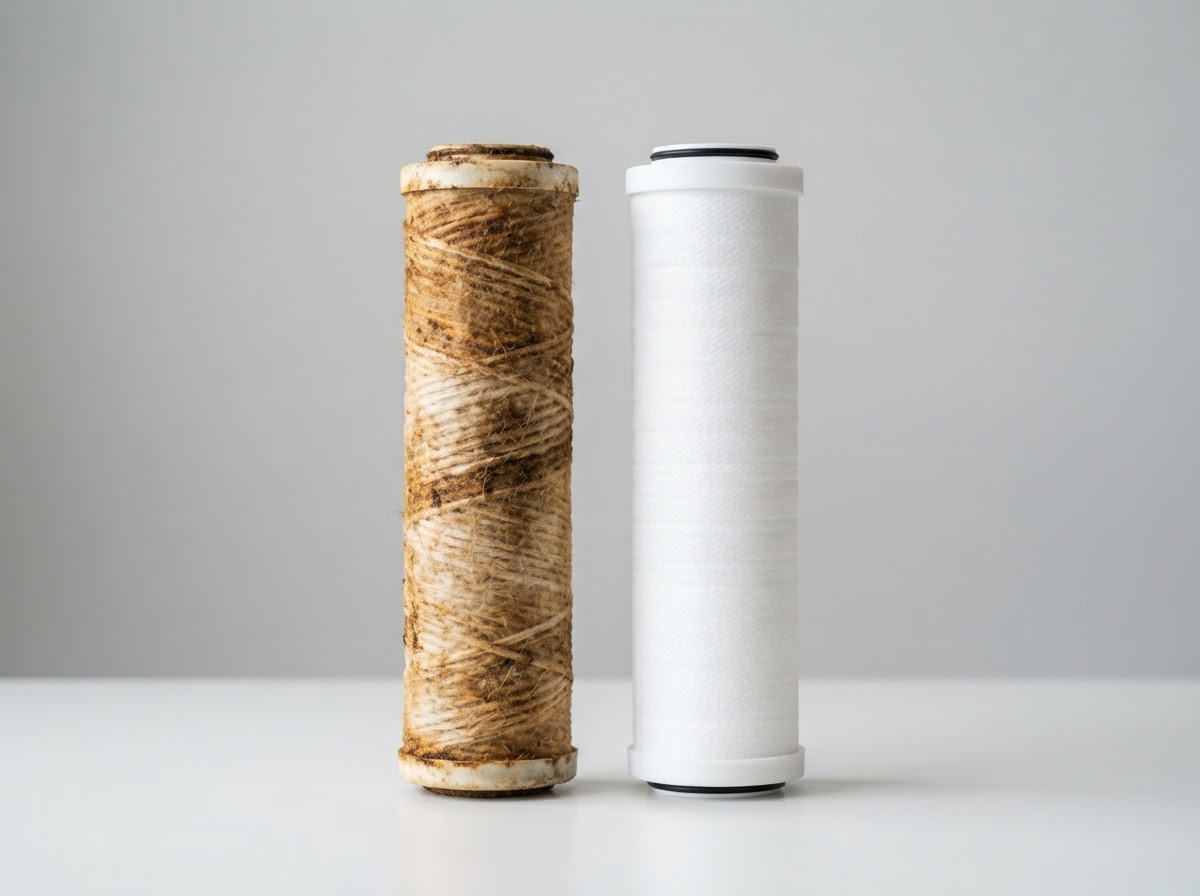
Why Do Water Filters Clog So Quickly?
Most mechanical water filters clog because particles build up in their filtration media and create resistance to water flow. However, a filter that needs replacement sooner than expected can have several possible causes.
More Particles Than Expected
A filter may collect suspended dirt, rust flakes, sand, or other material present in the water passing through it.
Filter Micron Rating Is Too Fine
A finer cartridge may capture smaller particles but become restrictive sooner under certain conditions.
Filter Capacity Is Too Small
An undersized cartridge may not accommodate the home's water demand or particle loading.
High Household Water Use
More water passing through the system can affect cartridge service life.
Plumbing or Distribution-System Disturbances
Material from plumbing or temporary water-flow changes may contribute to particle accumulation.
The Filter Is Due for Replacement
Every filter has maintenance requirements, and some reach their rated capacity before obvious flow problems appear.
These are possible causes, not a diagnosis for every home. The right next step depends on what is actually happening in your system.
What Happens Inside a Clogged Water Filter?
Mechanical Particle Filtration
Sediment filters physically retain particles based on the filter's construction and performance characteristics. As material accumulates, resistance to flow can increase. In some systems, this leads to noticeable pressure loss.
- New Sediment Cartridge
- Particle Accumulation
- Increased Flow Resistance
- Maintenance Needed
Adsorption-Based Filtration
Activated carbon filters can reduce specified substances through adsorption. Over time, adsorption sites may become exhausted. Unlike a mechanically clogged filter, an exhausted carbon filter may continue allowing normal water flow. That means water pressure alone cannot establish whether a carbon filter is still providing its intended contaminant-reduction performance.
- Carbon Media
- Treatment Capacity Used
- Cartridge Replacement Required
Mechanical clogging and adsorption exhaustion are different processes. A carbon filter that still flows normally is not necessarily still reducing contaminants as intended. NSF — changing water filters
Can Sediment Cause Water Filters to Clog Early?
Sediment filters are designed to capture certain suspended particles. Possible material may include sand, dirt, rust flakes, pipe deposits, or other suspended particles. The appearance of particles does not automatically establish their composition or source.
- Sand
- Dirt
- Rust flakes
- Pipe deposits
- Other suspended particles
A dirty sediment cartridge does not prove the water is unsafe. The filter may simply be collecting the material it was designed to capture. However, unusually frequent clogging may suggest that the filter size, capacity, particle load, or plumbing conditions need evaluation. Identifying the source matters before purchasing additional equipment.
A dirty filter is not a test
A sediment filter collecting material is often doing its job. Frequent clogging is a reason to investigate the source — not a reason to assume the water is unsafe.
Is Your Water Filter Micron Rating Too Small?
A micron is one-millionth of a meter. Common sediment cartridge ratings may include 50, 20, 10, 5, or 1 microns. These examples are not universal recommendations. A smaller micron rating generally targets smaller particles, but may also affect particle loading and pressure drop.
Nominal Rating
A nominal micron rating describes filtration performance under the manufacturer's specified criteria. The fraction of particles retained varies by product and testing method.
Absolute Rating
An absolute rating generally refers to a defined high level of particle retention at the stated size, based on the relevant manufacturer's test method.
Nominal and absolute ratings are not interchangeable. A 1-micron nominal filter should not be assumed to perform like every 1-micron absolute filter. More filtration is not automatically better when the equipment becomes restrictive or is inappropriate for the household flow. Do not select a specific micron rating without understanding the actual system and water conditions.
Could Your Water Filter Be Too Small?
Filters need to accommodate expected water demand. Important factors include cartridge surface area, filter housing size, rated flow, household water usage, incoming pressure, particle loading, and the number of fixtures served. A small cartridge serving an entire home can face different demands than a filter serving one drinking water faucet.
- Cartridge surface area
- Filter housing size
- Rated flow
- Household water usage
- Incoming pressure
- Particle loading
- Number of fixtures served
An undersized filtration system may require more frequent maintenance or produce unacceptable pressure loss. However, larger equipment is not automatically necessary for every property. System sizing should follow manufacturer specifications and actual household needs.
Under-Sink Filter
Usually treats water for one faucet and its intended drinking water demand.
Whole-House Filter
Typically treats incoming water for multiple household fixtures and needs adequate flow capacity.
Why Is My Water Filter Brown, Orange, or Rust-Colored?
Used filters may change color as they collect material. Brown or orange deposits could be associated with iron-containing particles, corrosion products, or other suspended material, but appearance alone cannot identify the substance. Other material may create different colors or textures.
A filter changing color is not, by itself, a reliable water safety test. If the homeowner is concerned about a specific substance, appropriate testing may be needed.
- Particles trapped in a sediment filter
- Dissolved substances
- Discoloration from plumbing materials
- Changes originating elsewhere in the water system
Do not assume all orange material is rust, and do not assume every brown filter indicates dangerous contamination. Appearance is a clue, not a test.
Why Might Water Filters Clog in Waltham, MA?
Waltham receives municipal drinking water through the Massachusetts Water Resources Authority. MWRA treats and monitors the public water supply, and the City of Waltham operates its local water distribution network. Water filters in individual homes may still experience clogging because of cartridge design, household plumbing, particle loading, equipment capacity, or maintenance conditions.
Temporary water distribution work can sometimes affect water appearance. For example, MWRA issued a public notice dated September 29, 2026, explaining that scheduled water infrastructure testing on September 30, 2026, could temporarily cause discolored water or lower water pressure in Waltham. MWRA also reported a separate pipeline-related event in August 2025 when some residents could experience temporary discoloration. These were specific, dated infrastructure activities. They do not establish an ongoing citywide sediment problem.
If a homeowner notices sudden discoloration, checking current utility notices and contacting the water supplier may be appropriate. For recurring filter clogging limited to one home, the filtration equipment or household plumbing may need evaluation.
Neighborhood names are listed for local reference only. No particular neighborhood is known to have higher sediment levels, and neighborhood alone does not establish a home's water conditions.
Is the Sediment Coming From Your Home's Plumbing?
Particles at One Faucet
A fixture-specific concern may involve a faucet, aerator, or nearby plumbing component.
Particles at Multiple Fixtures
A broader pattern may warrant checking household supply plumbing, treatment equipment, and current utility information.
Only Hot Water Is Affected
A problem limited to hot water may involve the water heater or hot-water plumbing.
After Plumbing Work
Temporary changes in water flow may mobilize material within plumbing.
After Municipal Water Work
Temporary disturbances may affect water appearance in affected service areas.
These patterns do not conclusively identify the cause. An appropriately qualified provider can help evaluate the equipment or plumbing as needed. Not every issue can be solved by installing a filter.
Can a Clogged Water Filter Reduce Water Pressure?
Yes. Some filters create more resistance to flow as particles accumulate. It helps to understand the difference between flow rate (how much water comes out) and pressure (the force behind it). A clogged cartridge commonly reduces flow first.
A homeowner may notice
- Slower water flow at a filtered faucet
- Reduced flow at multiple fixtures
- A larger pressure difference across a filter
- A filter that restricts flow soon after replacement
Other possible causes
- Partially closed valves
- Plumbing restrictions
- Equipment problems
- Insufficient supply pressure
- An undersized filtration system
A pressure problem should not automatically be blamed on the filter without evaluation. Do not open a pressurized system if you are unfamiliar with the equipment.
Talk through flow problems
Reduced flow can come from the filter, the plumbing, or the supply. A short call can help sort out which is most likely before you replace equipment.
Why Does a New Water Filter Clog Almost Immediately?
High Particle Loading
The incoming water may carry more suspended material than the cartridge can handle for the expected service interval.
Very Fine Filtration
A fine cartridge may become restrictive under certain particle-loading conditions.
Undersized Equipment
The installed system may not match water demand.
Plumbing or Distribution Disturbance
Changes in flow can sometimes mobilize deposits within plumbing.
Incorrect Cartridge
The cartridge may not be suitable for the housing, water conditions, or flow requirements.
Installation or System Problem
A fitting, valve, housing, or other equipment condition may affect flow.
Repeated cartridge replacement without identifying the cause can become expensive. A provider may need to assess system sizing, filter design, and water conditions.
Would a Different Micron Rating Help?
Changing the filter rating may alter particle capture, filter service life, flow resistance, and maintenance needs. A coarser cartridge may last longer under some particle-loading conditions, but could allow smaller particles through. A finer cartridge may capture smaller particles but become restrictive more quickly.
It is important to preserve any equipment-specific treatment requirements. For certified contaminant-reduction systems, changing to an unapproved cartridge may affect verified performance. Do not substitute cartridges solely based on physical fit. Check manufacturer specifications or discuss the change with a suitable provider.
Trade-offs at a glance
- Coarser cartridge
- May last longer under some particle loads, but can allow smaller particles through.
- Finer cartridge
- May capture smaller particles but become restrictive more quickly.
- Certified systems
- Changing to an unapproved cartridge may affect verified performance.
Should You Consider a Spin-Down Sediment Filter?
Certain spin-down systems use screens and flow arrangements to collect or separate larger suspended particles. Some designs allow accumulated material to be purged. They may be appropriate for selected applications involving certain particle sizes and loads.
- They do not automatically remove very fine sediment.
- They do not remove dissolved contaminants.
- They are not universal substitutes for cartridge filters.
- Their operation and maintenance depend on the actual design.
A spin-down filter may be part of a multi-stage sediment strategy when supported by the property's conditions. Appropriate sizing and installation are important.
Part of a strategy, not a cure-all
A spin-down filter can be one stage of a multi-stage sediment setup, but it does not replace the need to understand where particles are coming from.
Can Two-Stage Filtration Reduce Cartridge Clogging?
- Incoming Water
- Coarse Prefilter
- Finer Filter
- Household Plumbing
- The first stage targets larger particles.
- The second stage targets smaller particles within its rated performance.
- Both stages have maintenance requirements.
- Each stage introduces pressure loss.
- Additional equipment does not automatically solve the underlying sediment source.
Avoid prescribing exact micron ratings for every property. The system should be evaluated according to actual water conditions, desired treatment, and flow requirements.
What Should You Do If Your Water Filter Keeps Clogging?
Sudden Brown or Discolored Water After Utility Work
First check current MWRA or Waltham water notices. Follow any official water-use guidance. Do not assume a new filter is the correct immediate solution.
Only One Faucet Has Particles or Low Flow
The fixture, aerator, nearby plumbing, or point-of-use filter may need evaluation.
Whole-House Filter Requires Very Frequent Replacement
Review filter specifications, cartridge sizing, household flow, particle loading, and possible plumbing or supply conditions.
Reduced Flow After a Recent Cartridge Change
The replacement cartridge, housing, connections, or other plumbing may need inspection.
Water Tastes Normal but the Filter Is Past Its Service Life
Replace the cartridge according to manufacturer instructions. Normal taste does not prove contaminant-reduction performance.
The Concern Is About a Specific Contaminant
Use appropriate testing and choose a filter with verified reduction claims for that substance.
When you're unsure whether the problem is the filter, plumbing, or water supply, discussing the symptoms with an appropriate professional can help avoid unnecessary equipment purchases.
Should You Test Your Water If Filters Keep Clogging?
Testing can be useful when:
- The source of particles is unclear.
- Water appearance changes repeatedly.
- A particular substance is suspected.
- Equipment performance is uncertain.
- A homeowner is considering a major filtration upgrade.
- The property has a private or unfamiliar water source.
Not every clogged cartridge requires comprehensive laboratory testing. Testing should be targeted to the actual concern. Waltham Water Filtration Co. does not perform testing directly; we help homeowners connect with independent providers.
Different tests, different answers
- Turbidity
- Measures cloudiness of the water.
- Particle Analysis
- May provide different information than turbidity alone.
- Hardness Testing
- Measures calcium and magnesium.
- TDS Meters
- Do not directly measure suspended sediment.
- Lead and PFAS
- Require appropriate contaminant-specific methods and qualified laboratories.
How Often Should You Replace a Water Filter?
Replacement intervals depend on several factors:
- System type
- Cartridge type
- Manufacturer instructions
- Rated capacity
- Household usage
- Water conditions
- Filter performance requirements
Some mechanical cartridges become visibly clogged. Adsorptive media may reach its treatment capacity without producing noticeable pressure changes. Homeowners should not rely solely on color, taste, or water flow to determine whether every filter remains effective. EPA and NSF recommend using compatible replacement cartridges and changing them according to manufacturer guidance.
Practical maintenance checklist
- Keep the filter model information.
- Record replacement dates.
- Follow rated cartridge capacity.
- Use compatible replacement parts.
- Note unusual pressure changes.
- Check accessible equipment for leaks.
- Investigate persistent early clogging.
- Follow the manufacturer's system instructions.
There is no one universal schedule for every filtration system. Follow the manufacturer's guidance for your specific equipment. NSF — changing water filters · EPA — maintain your water filter
When Should You Consider Repair or a New Filtration System?
Routine cartridge changes may not solve:
- A damaged housing.
- Repeated leaks.
- Inadequate system capacity.
- Recurring clogging caused by another condition.
- Valve or fitting problems.
- Equipment no longer suited to the treatment goal.
Repair may be appropriate when compatible parts are available. Replacement may be appropriate when the equipment is no longer suitable or economical to maintain. However, changing equipment without identifying the cause may simply recreate the problem.
Find the cause first
Changing equipment without identifying why filters clog can simply recreate the problem in a new system.
Getting Help With Repeated Water Filter Clogging
Call About the Problem
Explain what kind of filter you have, how quickly it clogs, and whether you are also noticing particles or reduced flow.
Discuss Your Options
Waltham Water Filtration Co. helps homeowners connect with independent providers who can discuss maintenance, sediment filtration, testing, and equipment options.
Review the Recommended Next Step
Discuss potential service needs, installation requirements, and available pricing before proceeding.
Waltham Water Filtration Co. does not send technicians or operate a laboratory. We help homeowners connect with independent water treatment providers serving the area.
Related Water Filtration Services and Guides
Sediment Water Filtration
For homeowners considering particle filtration systems.
Learn moreWater Filter Replacement
For cartridge changes and routine maintenance.
Learn moreWater Filtration Repair
For leaks, equipment faults, and pressure problems.
Learn moreWater Testing
For investigating water characteristics or suspected substances.
Learn moreWhole-House Water Filtration
For treatment serving multiple fixtures.
Learn moreWaltham Water Quality
For official local drinking water information.
Learn moreWater Filter Clogging FAQs
Straight answers about why filters clog, sediment, micron ratings, pressure, and maintenance.
Why does my whole-house water filter clog so fast?+
A whole-house filter may clog quickly because of particle loading, filter sizing, micron rating, household demand, or plumbing conditions. The best solution depends on why the filter is becoming restricted. Replacing the cartridge repeatedly without investigating the cause may not solve the problem. Call to discuss your system and available filtration options.
Why does my sediment filter turn brown?+
Brown or orange deposits may be associated with trapped particles, including certain corrosion products or other material. Color alone does not establish the exact substance or its source. A used sediment filter may simply be capturing particles as intended. Persistent or unusual changes may warrant further evaluation.
Can a clogged water filter reduce water pressure?+
Yes. Some filters become more resistant to flow as particles accumulate. However, low pressure can also result from valve problems, undersized equipment, plumbing restrictions, or supply issues. The filtration system should be evaluated before assuming that the cartridge is responsible.
Is a 1-micron filter better than a 5-micron filter?+
Not automatically. A smaller micron rating generally targets smaller particles, but the actual filtration performance depends on the cartridge design and rating method. A finer filter may also clog faster under certain water conditions. The most appropriate rating depends on the treatment goal and household flow requirements.
Will a spin-down filter stop my sediment cartridges from clogging?+
A spin-down filter may help capture or separate certain larger particles, depending on its screen and design. It does not automatically remove fine sediment or solve every cause of rapid cartridge clogging. A multi-stage filtration setup may be worth evaluating when appropriate.
Why does my new water filter clog immediately?+
Possible causes include high particle loading, an excessively fine cartridge for the application, undersized equipment, incorrect replacement components, or a plumbing or system restriction. A provider can help assess which factors may be involved rather than simply installing another cartridge.
Does a dirty water filter mean my tap water is unsafe?+
No. A sediment filter is designed to collect particles, and visible material does not by itself establish a health hazard. However, appearance cannot rule out every water quality concern either. When a specific contaminant is suspected, appropriate testing and official water supplier information are important.
Can water-main work cause my filter to clog?+
Temporary changes in distribution-system flow can sometimes mobilize material and cause discoloration. MWRA documented past Waltham infrastructure activities when temporary discoloration was possible. These specific events do not establish an ongoing water problem. Check current utility notices if water appearance changes suddenly.
How often should I replace my sediment water filter?+
The replacement schedule depends on cartridge type, system design, particle loading, manufacturer instructions, and water use. Some filters need maintenance sooner under heavy particle loading. Follow the specified service schedule and investigate unusually rapid clogging rather than assuming one replacement interval applies to every home.
Should I install a bigger whole-house filter?+
A larger filter may be useful when the existing system is undersized for water demand or particle loading. However, larger equipment does not automatically solve problems caused by plumbing, temporary distribution disturbances, or an inappropriate treatment design. Call (781) 226-3613 to discuss filtration and replacement options.
Tired of Replacing Water Filters Too Often?
If your water filter keeps clogging, your water pressure has dropped, or you're noticing particles that weren't there before, the next step is understanding what's causing the problem. Sometimes a compatible replacement cartridge is all that's needed. Other situations may call for equipment evaluation, sediment filtration, water testing, or repairs. Waltham Water Filtration Co. helps homeowners explore these options and connect with independent water treatment providers serving Waltham, Massachusetts. Call to discuss your filter and available next steps.