Sediment Water Filtration in Waltham, MA
Finding particles in your water or dealing with a filter that clogs much faster than expected? Sediment filtration systems are designed to capture certain suspended particles before they reach downstream plumbing, fixtures, or water treatment equipment.
Depending on the system, sediment filters may capture sand, dirt, rust flakes, or other particulate material. Waltham Water Filtration Co. helps homeowners explore sediment filtration options and connect with independent water treatment providers serving Waltham, Massachusetts.
Whether you need a new sediment filter, help with an existing system, or information about recurring particle problems, call to discuss available options.
- Whole-House Sediment Filters
- Spin-Down Filtration
- Sediment Cartridge Replacement
- Filter Clogging & Flow Problems
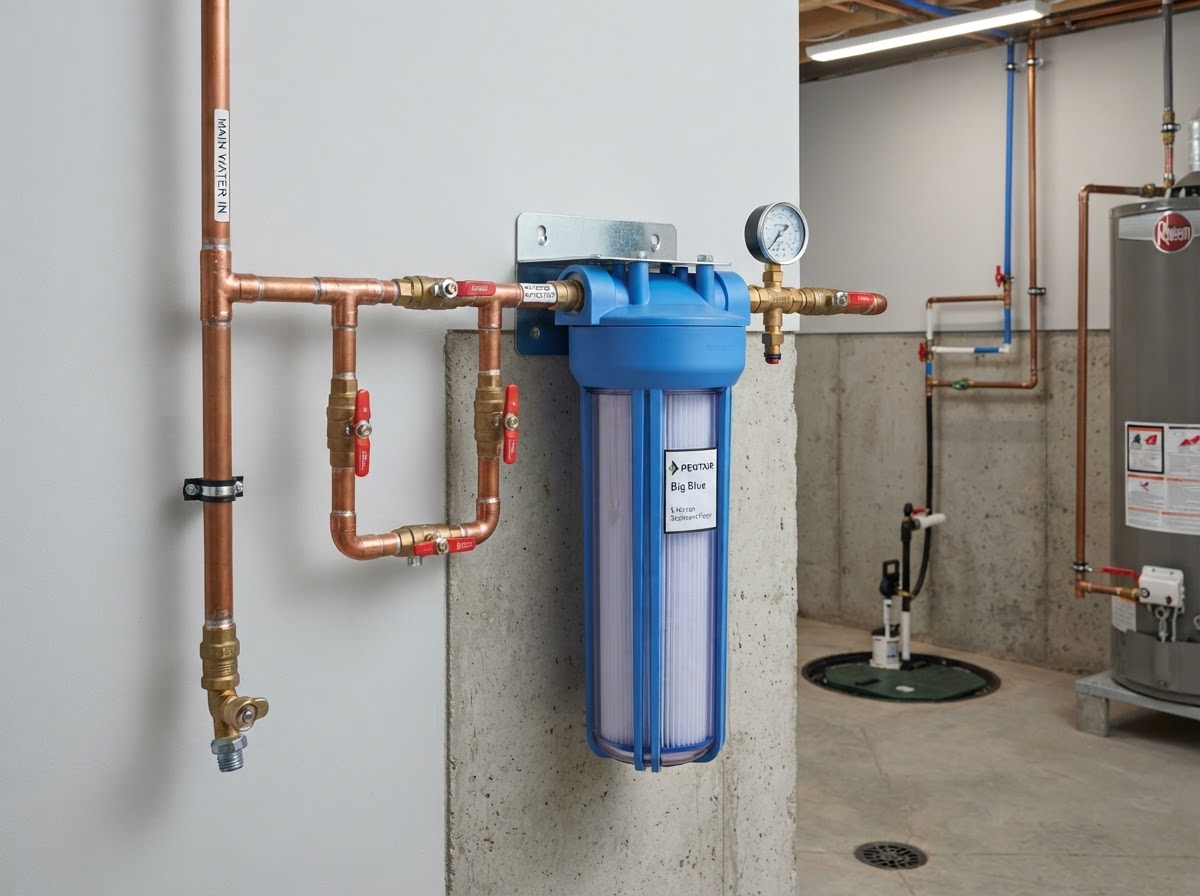
How Does Sediment Water Filtration Work?
Sediment filtration is primarily a physical particle-removal process. Water passes through a filter medium or screen designed to retain particles based on the filter's characteristics.
Captured material accumulates in the filter or is collected and discharged through an appropriate cleaning mechanism. Depending on the system, filtration may involve:
- Pleated cartridges.
- Spun polypropylene cartridges.
- String-wound cartridges.
- Screen filters.
- Spin-down separators.
- Backwashing sediment filters.
Sediment filtration is different from activated carbon filtration and reverse osmosis. A sediment filter is not automatically designed to reduce dissolved minerals, PFAS, lead in dissolved form, chlorine, bacteria, or other specific contaminants. Its capabilities depend on the actual product design and verified performance claims. The system must be sized correctly for the expected flow.
Particles are captured or separated within the equipment. The system must be sized correctly for the expected flow.
Signs You May Need to Investigate Sediment in Your Water
Different symptoms can point to different causes. Understanding the problem is the first step toward choosing the right response.
Visible Particles in Water
Some homeowners notice small particles collecting in a glass, faucet aerator, or plumbing fixture. These particles may have different sources, and their appearance alone cannot reliably establish their composition.
Filters Clogging Too Quickly
A filter that requires replacement unusually often may be capturing more material than expected. However, the cause may involve filter sizing, particle loading, household usage, or plumbing conditions.
Brown or Rust-Colored Water
Brown or reddish water may result from disturbed deposits or corrosion products in certain situations. Do not assume that every instance of brown water is caused by the same material.
Reduced Water Flow
A filter that becomes loaded with particles can create resistance to flow. Other plumbing problems can also reduce water pressure.
Particles in Faucet Aerators
Material may collect in faucet screens or aerators. Its origin may involve household plumbing or distribution-system conditions.
Sediment Affecting Existing Filters
Sediment prefiltration may sometimes be appropriate to protect downstream treatment equipment from particle loading. Equipment selection should follow manufacturer recommendations.
What Causes Sediment or Particles in Household Water?
Particles can originate from several sources. Correctly identifying the source is important before recommending a filtration system.
Water Distribution Disturbances
Changes in water flow during maintenance, hydrant operation, or water-main work can sometimes mobilize material within distribution systems.
Household Plumbing
Corrosion products or deposits associated with internal piping may contribute particles.
Private Water Sources
Some private wells can carry sand or other suspended material depending on their construction and local conditions. Most Waltham homes do not use private wells.
Existing Water Treatment Equipment
Improperly maintained or damaged treatment equipment may contribute to unusual water appearance or particle problems in some circumstances.
Water Heater or Fixture-Specific Conditions
If the problem appears only in hot water or at one fixture, the source may differ from a problem affecting all cold-water taps.
Trapped Air
Milky or cloudy water may sometimes be caused by tiny air bubbles rather than sediment. Cloudiness does not always prove solid particles are present.
Correctly identifying the source is important before recommending a filtration system.
Sediment and Water Discoloration in Waltham, MA
Waltham receives municipal drinking water through the Massachusetts Water Resources Authority (MWRA). The public water supply is monitored and treated according to applicable drinking water requirements. However, temporary disturbances in water distribution systems can sometimes affect water appearance or pressure.
These are documented infrastructure events. They do not establish that Waltham has a permanent or citywide sediment contamination problem. If homeowners experience sudden water discoloration, they should check current water supplier notices and contact the appropriate utility when warranted. Persistent particle problems involving an existing household filter or plumbing system may require a different investigation.
MWRA announced scheduled infrastructure testing in Waltham. Its public notice stated that some residents could temporarily experience discolored water or reduced water pressure during the testing.
MWRA — Scheduled Water Infrastructure Test (Waltham, 09/30/26)MWRA issued a notice related to a pipeline connection near Lexington Street and Totten Pond Road, explaining that temporary discoloration could occur during that project.
MWRA — Section 101 Extension Public Notice (Waltham)Waltham neighborhoods
South Side • Warrendale • Cedarwood • Lakeview • Piety Corner • The Highlands
These neighborhood references are geographic only. There is no evidence that any one Waltham neighborhood has different sediment levels than another.
Types of Sediment Water Filtration Systems
A useful comparison of the most common sediment filtration options for residential use.
Pleated Sediment Filters
Pleated filters use folded filtration media that provide relatively large surface area within the cartridge. Depending on the product, some pleated cartridges can be cleaned and reused, while others are disposable. Not every pleated cartridge is washable.
Spun Polypropylene Filters
These filters use layers of polypropylene fibers to capture certain particles. Their construction may provide depth filtration, depending on the design. Replacement is typically based on manufacturer recommendations, capacity, or operating conditions.
String-Wound Sediment Filters
String-wound filters use fibers wrapped around a central core. They are designed to capture particles within their rated filtration characteristics. Different materials and ratings are available.
Spin-Down Sediment Filters
Spin-down systems may use a screen and flow configuration to separate or collect larger particles. Some designs include a purge valve for removing accumulated material. Their suitability depends on particle size, water conditions, and flow rate. Not every spin-down filter removes very fine sediment.
Backwashing Sediment Filters
Some sediment filtration equipment uses automatic or manual backwashing to clear accumulated material. These systems may be considered for certain higher-particle-load applications. Installation and maintenance requirements differ from disposable cartridge filters.
Multi-Stage Sediment Filtration
Some systems use more than one filtration stage, often with progressively finer filtration. The stages should be selected to match actual particle loading, flow requirements, and treatment goals. More stages do not automatically mean better performance.
What Micron Rating Should a Sediment Water Filter Have?
A micron, or micrometer, is one-millionth of a meter. Sediment filters are rated by the size of particles they are designed to capture.
Sediment filters may have ratings such as:
These are examples of commonly marketed ratings, not recommendations for every Waltham property. Smaller micron ratings generally target smaller particles, but actual filter performance depends on the media and rating method.
Nominal Micron Rating
A nominal rating describes particle retention under a manufacturer's specified criteria. The percentage captured can vary by product.
Absolute Micron Rating
An absolute rating generally refers to a specified high particle-retention threshold, but exact meaning depends on the testing method and manufacturer's definition.
Nominal and absolute ratings are not interchangeable. Selecting a very fine cartridge without accounting for sediment loading and water flow can lead to premature clogging or unacceptable pressure drop. The best filter is not necessarily the one with the smallest micron rating.
Whole-House Sediment Filter Installation
Whole-house sediment filtration systems are commonly installed near the home's incoming main water supply, providing particle filtration before water reaches many downstream fixtures or treatment components.
Important considerations
- Installation location.
- Available space.
- Incoming water pressure.
- Household flow demand.
- Filter capacity.
- Expected particle loading.
- Maintenance access.
- Plumbing connections.
- Drainage needs for self-cleaning or backwashing systems.
An undersized filter can restrict water flow. An installation provider should consider the actual equipment and plumbing configuration. This page does not provide detailed DIY plumbing modification instructions.
Can Sediment Filters Reduce Water Pressure?
All filtration equipment introduces some resistance to water flow. Pressure loss can increase as some filters accumulate particles.
The effect depends on
- Filter media.
- Cartridge size.
- Flow rate.
- System configuration.
- Particle loading.
- Maintenance condition.
A filtration system should be selected and sized for expected household demand. A new sediment filter will not automatically increase water pressure. If an existing filter is restricting flow, appropriate maintenance may help, but other plumbing issues may also require evaluation.
Sediment Filter Replacement & Maintenance
Sediment filters need maintenance appropriate to their design. The right interval depends on the equipment, water conditions, and household usage.
Cartridge Replacement
Disposable sediment cartridges need replacement according to manufacturer instructions and actual operating conditions.
Screen Cleaning
Some screen-based systems require periodic cleaning or purging.
Backwashing Systems
Backwashing equipment must be maintained according to the equipment specifications.
Monitoring Flow
Changes in flow or pressure may indicate increasing restriction.
Inspecting Filter Housings
Leaks, damaged seals, or housing problems may require repair.
Recurring Sediment Problems
Repeated early clogging may warrant an evaluation of the source, filter design, or water conditions.
Not all sediment filters should be replaced on one universal schedule. Replacement depends on the equipment, water conditions, and household usage.
Should You Test Your Water Before Installing a Sediment Filter?
Not every visible particle problem requires specialized laboratory analysis, but investigation may be useful when the source is unclear.
Investigation may be useful when
- The source of particles is unknown.
- Water discoloration persists.
- Filters repeatedly clog prematurely.
- The issue occurs only at certain fixtures.
- A homeowner has a specific contaminant concern.
- The property uses an unfamiliar water source.
A water sample may be evaluated for appropriate physical or chemical parameters depending on the concern. Turbidity measurements describe cloudiness but do not identify every particle or contaminant. A total dissolved solids meter does not measure sediment concentration directly. Testing should match the actual concern. If the water supplier has issued an advisory, follow its official instructions rather than assuming a household filter makes the water safe.
How Much Does Sediment Water Filtration Cost?
Pricing depends on the equipment, installation, and long-term maintenance. A useful quote clarifies what is included.
Factors that affect pricing
- Filter type.
- Cartridge versus screen or backwashing system.
- System capacity.
- Equipment size.
- Installation location.
- Plumbing modifications.
- Maintenance requirements.
- Cartridge replacement frequency.
- Additional equipment needed.
- Existing filtration system condition.
A basic cartridge housing and a larger self-cleaning whole-house system can have very different installation and maintenance requirements. This page does not invent Waltham-specific price ranges or advertise free testing, free installation, or guaranteed pricing.
When Should You Investigate the Water Source or Plumbing First?
Installing a sediment filter is not the solution to every instance of discolored or cloudy water. Accurate diagnosis can prevent unnecessary equipment purchases.
Temporary Utility Work
Sudden discoloration related to known water-main work may require following instructions from MWRA or the City of Waltham.
Fixture-Specific Problems
Particles at only one faucet may require investigation of that fixture or its plumbing.
Hot-Water-Only Problems
Sediment or discoloration only in hot water may involve the water heater or hot-water plumbing.
Recurring Equipment Problems
A repeatedly clogged filter may need evaluation rather than constant replacement.
Unknown Contamination Concerns
A particle filter cannot be assumed to make water safe for drinking when a specific contamination concern exists.
If customers are under a drinking water advisory, they must follow the issuing authority's instructions. Accurate diagnosis can prevent unnecessary equipment purchases.
Getting Help With Sediment Water Filtration
A simple three-step process connects you with a provider who can discuss equipment, testing, and pricing.
- 1
Call About the Problem
Tell us whether you're noticing particles, clogged filters, water discoloration, or reduced water flow.
- 2
Discuss Filtration Options
We help connect homeowners with independent water treatment providers who can discuss equipment, testing, or evaluation options.
- 3
Review the Recommended Next Step
Discuss available filtration systems, installation requirements, maintenance, and pricing before proceeding.
Related Water Filtration Services
Explore other common water filtration and treatment options for Waltham-area homes.
Whole-House Water Filtration
Treat water at the main line for every tap in the home.
Water Filter Replacement
Routine cartridge replacement and scheduled maintenance.
Water Filtration Repair
Diagnose and service filtration systems with leaks or faults.
Water Testing
Find out what is actually in your water before choosing a system.
Water Filtration Installation
Professional installation for new whole-house and under-sink systems.
Why Water Filters Clog
Common causes behind filters that clog sooner than expected.
Sediment Water Filtration FAQs
Common questions about sediment filters, clogging, and installation in Waltham.
Why am I seeing sediment in my tap water?+
Particles can have several possible sources, including disturbances in water distribution, household plumbing deposits, fixture-related issues, or private water sources. Their appearance alone does not identify their composition. If the problem appeared suddenly, checking water supplier notices may be a useful first step. Call to discuss sediment filtration options.
What type of filter removes sediment from water?+
Sediment filters use screens, cartridges, or other physical filtration media to capture certain suspended particles. Common options include pleated cartridges, spun polypropylene filters, and spin-down systems. The correct choice depends on particle size, flow requirements, and the actual water conditions. Call to compare sediment filtration options.
What micron rating is best for a whole-house sediment filter?+
There is no single micron rating that works best for every home. Finer filtration may capture smaller particles, but can also result in more frequent clogging or greater pressure loss under certain conditions. Filter capacity, the manufacturer's rating method, and household demand should guide equipment selection. Call for help exploring options.
Why does my sediment water filter clog so quickly?+
Rapid clogging may be related to particle loading, a cartridge that is too fine for the application, undersized equipment, high water usage, or plumbing conditions. Repeated replacement without investigating the cause may not solve the problem. Call about a frequently clogged sediment filter.
Can a sediment filter remove rust from water?+
Certain sediment filters can capture suspended rust particles or flakes within their rated filtration capabilities. However, they are not necessarily designed to remove dissolved iron or correct corroding plumbing. Understanding the form and source of the material matters. Call to discuss filtration options.
Can a sediment filter cause low water pressure?+
A sediment filter introduces resistance to flow, and a clogged or undersized cartridge can increase that resistance. However, other plumbing or supply problems may also cause low pressure. The filtration equipment should be evaluated before assuming it is responsible. Call about water flow concerns.
Does brown water mean I need a whole-house sediment filter?+
Not necessarily. Brown or discolored water may sometimes occur temporarily during distribution-system work or other disturbances. A homeowner should check current water supplier notices and investigate persistent problems before purchasing treatment equipment. A sediment filter may help with certain particle concerns but is not always the appropriate response. Call to discuss your options.
How much does sediment water filtration installation cost in Waltham?+
Pricing varies based on the filter type, equipment capacity, installation requirements, plumbing configuration, and long-term maintenance. A basic sediment cartridge setup is different from a larger backwashing system. Call (781) 226-3613 to discuss your situation and available pricing.
Dealing With Sediment or Clogged Water Filters in Waltham?
If you're noticing particles in your water, replacing filters more often than expected, or dealing with reduced water flow, it helps to understand what's causing the problem before choosing equipment. Waltham Water Filtration Co. helps homeowners explore sediment filtration and maintenance options and connect with independent providers serving the Waltham area. Call to discuss your water concerns and available next steps.