Whole-House vs. Under-Sink Water Filtration: Which Is Right for Your Home?
Thinking about adding a water filtration system but not sure whether you need a whole-house filter or an under-sink drinking water system? The biggest difference is where the water gets treated.
Whole-house filtration systems are generally installed near the main water supply and treat incoming water before it reaches multiple household fixtures. Under-sink filtration systems treat water at a specific location, usually the kitchen sink. Both can be useful, but they serve different needs. This guide compares installation, treatment capabilities, maintenance, costs, and the situations where each option may make sense for homeowners in Waltham, Massachusetts. Waltham Water Filtration Co. helps homeowners explore filtration options and connect with independent providers serving the area.
- Installation & Treatment Location
- Contaminant Reduction vs. Coverage
- Maintenance & Cost Comparison
- Waltham Water Context
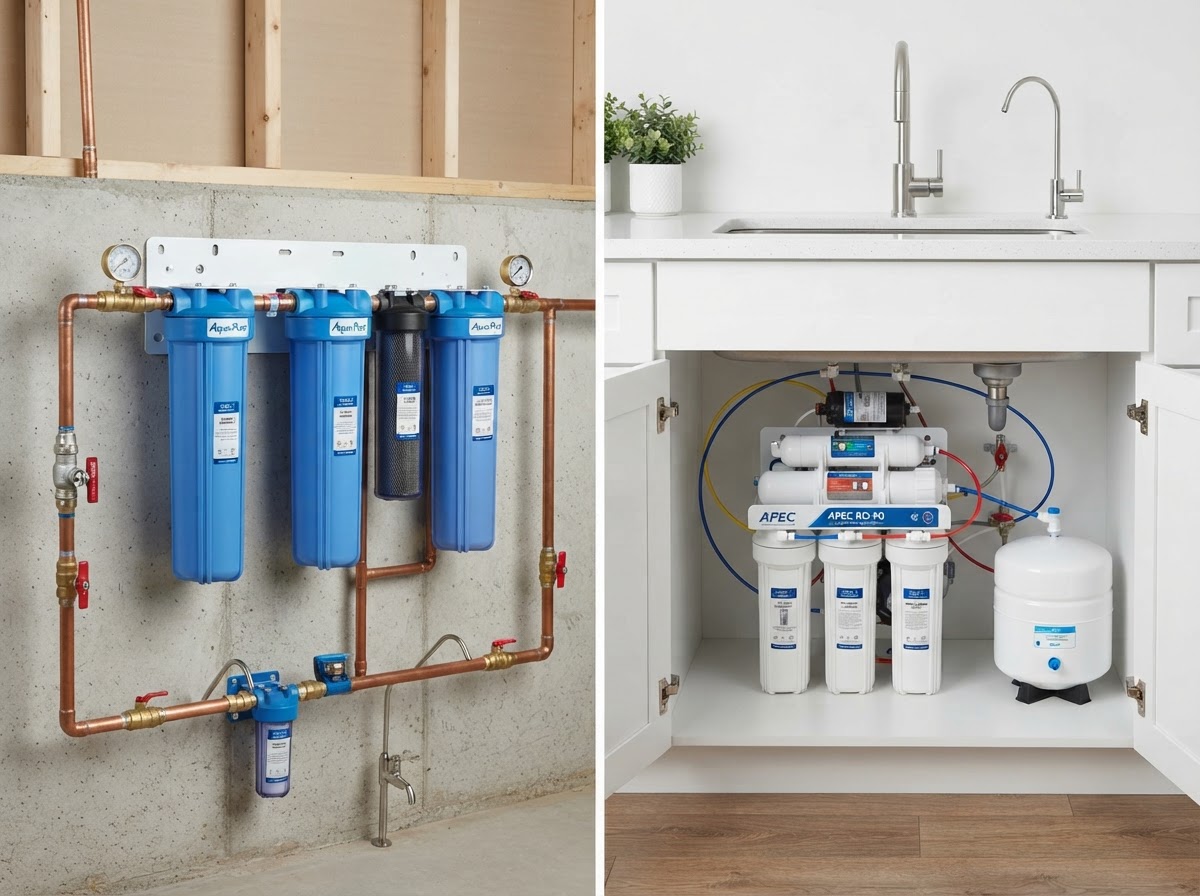
Whole-House or Under-Sink Filtration?
Whole-House Filtration May Make Sense When
You have a treatment goal affecting water at multiple fixtures throughout the home. Examples may include suspended sediment entering household plumbing or another specific treatment need for which whole-home equipment is appropriate.
Under-Sink Filtration May Make Sense When
Your main goal is improving or treating water used for drinking and cooking at the kitchen sink. For many households, point-of-use treatment is a simpler and less extensive option.
You May Not Need Either When
Your municipal water meets applicable standards and you do not have an additional treatment goal that justifies filtration.
A whole-house system is not automatically safer, and an under-sink system is not automatically less effective. The relevant factor is whether the specific equipment has verified performance for the substances and water uses involved. Equipment should be chosen based on the actual concern, not simply the number of faucets in the home.
Whole-House vs. Under-Sink Water Filters: Side-by-Side
| Feature | Whole-House Filtration | Under-Sink Filtration |
|---|---|---|
| Treatment location | Main incoming water line | Near a specific sink |
| Water treated | Multiple fixtures throughout the home | One faucet or designated drinking water outlet |
| Primary use | Whole-home treatment goals | Drinking and cooking water |
| Common systems | Sediment, carbon, specialty media | Carbon filters, specialty media, reverse osmosis |
| Water flow requirements | Sized for household demand | Sized for point-of-use demand |
| Installation | Usually more extensive plumbing work | Usually localized plumbing work |
| Equipment size | Often larger | Often compact |
| Typical initial cost | Generally higher | Generally lower |
| Maintenance | Cartridges, media, backwashing where applicable | Cartridges and membranes depending on system |
| Best choice | When treatment is needed across multiple fixtures | When treatment is mainly needed for drinking water |
The most important distinction is the treatment goal. A system serving the entire home may be unnecessary if the only concern is drinking water at one faucet. Conversely, a kitchen filter will not treat water at other fixtures. This table is a general comparison, not a universal price quote or guarantee.
How Does Whole-House Water Filtration Work?
Whole-house filtration is also called point-of-entry filtration. The system is typically installed near the main water line entering the home. Water passes through the equipment before traveling to multiple household fixtures.
Depending on the system, filtration may target:
- Suspended particles
- Certain taste or odor compounds
- Specific substances covered by verified treatment claims
- Other property-specific water treatment goals
Whole-house equipment can include:
- Sediment cartridge systems
- Activated carbon filters
- Larger media tanks
- Multi-stage filtration
- Specialty treatment equipment
Not every whole-house system uses the same technology. Not every system removes lead, PFAS, dissolved minerals, microorganisms, or all chemicals. System sizing, flow rate, contact time, media capacity, and maintenance affect actual performance.
Treatment path
- 1Main Water Supply
- 2Whole-House Filter
- 3Household Plumbing
- 4Faucets, Showers & Appliances
How Does Under-Sink Water Filtration Work?
Under-sink filtration is a point-of-use treatment method. It treats water near the place where it will be used, usually at the kitchen sink. Some systems connect to the existing faucet. Others supply water through a dedicated drinking water faucet.
Common technologies include:
- Activated carbon
- Carbon block filtration
- Specialty adsorptive media
- Multi-stage filtration
- Reverse osmosis
Under-sink filters may be used to address particular drinking water goals based on the equipment's verified reduction claims. Unlike whole-house filtration, under-sink systems do not normally treat water used in the rest of the home.
For reverse osmosis, an additional drain or reject-water stream is involved. The membrane separates treated water from a concentrate stream that is sent to the drain.
Treatment path
- 1Cold Water Line
- 2Under-Sink Filter
- 3Drinking Water Faucet
Which Water Filtration System Covers More of Your Home?
Whole-house equipment generally treats a greater total volume of household water. This can include water for bathrooms, showers, laundry, kitchen fixtures, and other downstream plumbing, depending on the installation.
- Bathrooms
- Showers
- Laundry
- Kitchen fixtures
- Other downstream plumbing, depending on the installation
However, more water treated does not necessarily mean a better outcome. Some water uses may not need additional filtration. Under-sink treatment concentrates equipment capacity on drinking and cooking water, which may be more practical when the main goal is improving water at one faucet. The location of water use affects system selection. Not every fixture requires filtered water.
More water is not always better
Treating a greater volume of water does not automatically produce a better outcome. The right question is which water uses actually benefit from treatment.
What If Your Main Problem Is Sediment?
Sediment refers to particles suspended in water. Whole-house sediment filtration may be appropriate when particles are entering multiple fixtures or affecting downstream equipment. Possible material may include sand, rust flakes, pipe deposits, or other suspended particles.
- Sand
- Rust flakes
- Pipe deposits
- Other suspended particles
The source should be investigated. If particles appear only at one faucet or only in hot water, a different plumbing or equipment issue may be responsible. An under-sink sediment filter may protect a particular drinking water system, but it does not necessarily solve a problem affecting the rest of the home. Cartridge micron ratings and filter capacity matter, but specific micron recommendations should not be made without water information.
Where is it coming from?
Particles at one faucet, particles only in hot water, or particles across the whole home can point to very different causes. Identify the source before choosing equipment.
Which Filter Is Better for Drinking Water Taste?
Some carbon-based filtration systems can reduce specific taste and odor compounds. Depending on the actual goal, an under-sink filter may provide a practical option without treating water for the entire home. Whole-house carbon filtration may be considered when a particular treatment goal involves multiple fixtures.
However, the equipment should have verified performance for the substances involved. Waltham receives MWRA water, which uses monochloramine for residual disinfection. Chloramine and free chlorine are different. Not every ordinary carbon filter is designed or certified to reduce chloramine. Homeowners with chloramine-related treatment goals should choose equipment with verified applicable claims. Not all carbon filters work identically.
Chloramine is not chlorine
MWRA uses monochloramine, which is different from free chlorine. Look for filters with verified chloramine-reduction claims rather than assuming every carbon filter performs the same.
Which Type of Filter Makes Sense for Lead Concerns?
Lead in drinking water can be associated with certain plumbing materials and fixtures. This matters when deciding where to treat the water. A whole-house filter located before interior plumbing does not automatically address lead that may enter the water afterward through fixtures or plumbing inside the building.
For drinking and cooking water, EPA provides guidance on selecting certified point-of-use filters. Homeowners should look for:
- An explicit NSF/ANSI 53 lead-reduction claim
- Applicable particulate reduction claims under NSF/ANSI 42 when following EPA guidance
- Product-specific verification
- Correct replacement cartridges
- Proper maintenance
Not every under-sink system reduces lead. Appropriate water testing and evaluation of plumbing sources may be important. For drinking and cooking water, EPA provides guidance on selecting certified point-of-use filters with specific lead-reduction claims.
Location matters for lead
A filter installed before interior plumbing does not address lead that may enter water from fixtures or pipes inside the home. Point-of-use treatment at the kitchen sink is often the relevant location for drinking water.
What About PFAS or Other Contaminants?
Treatment should be matched to the specific substances of concern. Some activated carbon, reverse osmosis, and specialty media systems have verified claims for particular contaminants. However, a generic whole-house carbon system or standard under-sink filter should not automatically be assumed to reduce every contaminant.
A point-of-use system may be a practical option for some drinking water treatment goals. Whole-house treatment may be appropriate in certain circumstances, but it generally requires additional sizing and maintenance considerations. The exact system performance matters more than its installation location.
Customers should:
- 1Identify the contaminant.
- 2Review current public water reports.
- 3Use appropriate testing where needed.
- 4Review verified product performance.
- 5Understand installation and replacement requirements.
Performance over placement
The exact system performance matters more than its installation location. A certified point-of-use filter may outperform a generic whole-house system for a specific contaminant.
Which Filtration System Makes Sense for Waltham Homes?
Waltham receives municipal drinking water through the Massachusetts Water Resources Authority (MWRA). MWRA's water comes from the Quabbin and Wachusett reservoir system and undergoes treatment and monitoring. MWRA reports that its drinking water is naturally soft, with typical hardness of approximately 16 mg/L, or about 1 grain per gallon. That means most homes on the municipal water supply do not automatically need an additional softener.
MWRA also uses monochloramine as a residual disinfectant. Some homeowners may consider filtration for taste preferences, specific treatment goals, or concerns involving household plumbing or existing filtration equipment. However, municipal water quality information does not establish that every Waltham home needs a new filter.
For homeowners primarily interested in drinking and cooking water, an under-sink system may be worth comparing first. For treatment goals affecting several fixtures, whole-house filtration may be appropriate. If a homeowner is experiencing particles, rapid filter clogging, or unexpected discoloration, identifying the cause before selecting equipment is important.
Waltham includes a range of residential properties, from older houses to newer construction and renovated homes. Neighborhoods across the city — including South Side, Cedarwood, Warrendale, Lakeview, Piety Corner, The Highlands — share a common MWRA municipal supply, though individual homes vary in plumbing age, fixtures, and existing equipment.
Neighborhood names are listed for local reference only. No particular neighborhood is known to have different water-quality conditions, and neighborhood alone does not establish a home's water conditions, plumbing materials, or contaminant levels.
Official MWRA reference
MWRA describes its drinking water as naturally soft, with typical hardness around 1 grain per gallon, and uses monochloramine for residual disinfection.
MWRA tap water FAQsHow Does Installation Differ?
Whole-House Filter Installation
Typical considerations:
- Main water line access
- Adequate installation space
- Household flow and pressure
- Equipment capacity
- Plumbing modifications
- Bypass valves where appropriate
- Service access
- Drainage needs for certain systems
Under-Sink Filter Installation
Typical considerations:
- Cabinet space
- Cold-water supply connection
- Existing versus dedicated faucet
- Filter cartridge accessibility
- Suitable connections
- Drain access for reverse osmosis
- Electrical power for certain tankless RO systems
Installation requirements vary by equipment. Applicable plumbing work should follow Massachusetts requirements and manufacturer instructions. This page does not provide detailed DIY plumbing modification directions.
Is Whole-House Filtration More Expensive Than Under-Sink Filtration?
Whole-house systems generally have higher initial equipment and installation costs because they treat larger volumes of water and may require more extensive plumbing work. Under-sink systems generally involve less equipment and a smaller installation area. However, costs vary significantly.
Important factors include:
- Equipment technology
- Certified treatment claims
- System capacity
- Installation complexity
- Plumbing modifications
- Filter replacement
- Maintenance
- Water use and waste for RO systems
- Long-term operating requirements
An advanced under-sink reverse osmosis system may cost more than a basic whole-house sediment cartridge setup in some circumstances. Whole-house systems are not always more expensive in every comparison. Total ownership cost matters. This page does not invent local prices or equipment quotes.
Total ownership cost
Upfront price is only one part of the equation. Cartridges, membranes, media, and servicing all affect what a system costs over time.
Which System Is Easier to Maintain?
Whole-House Systems
May require:
- Sediment cartridge replacement
- Carbon media replacement
- Periodic backwashing
- Monitoring pressure loss
- Inspection of housings and valves
Under-Sink Systems
May require:
- Carbon cartridge replacement
- Sediment prefilter changes
- RO membrane maintenance where applicable
- Inspection of tubing and fittings
- Manufacturer-specified servicing
Some simple under-sink systems may have relatively straightforward maintenance. Some larger whole-house systems may involve more extensive servicing. However, certain whole-house designs have automated maintenance features, and some under-sink systems have multiple components. There is no one universal replacement schedule. Follow manufacturer requirements.
Can a Home Have Whole-House and Under-Sink Filtration?
Yes, when there is a defined reason for each system. Some homeowners may use whole-house sediment filtration for incoming particles and a separate under-sink drinking water filter for a specific treatment goal. Other households may use a different combination of technologies.
A combined system should be selected based on actual water conditions and equipment compatibility. More stages or more equipment do not automatically mean safer or better water. Sometimes a single well-chosen filter is sufficient. Sometimes no additional filtration is needed.
A common combination
- Whole-house sediment filtration for incoming particles
- A separate under-sink filter for a specific drinking water goal
Is a Water Softener the Same as Whole-House Filtration?
No. A conventional water softener uses ion exchange to reduce calcium and magnesium hardness. Water filtration systems may use carbon, membranes, sediment media, or specialized treatment methods to address different goals. A softener is not automatically designed to remove lead, PFAS, or all drinking water contaminants.
Because MWRA municipal water is naturally soft, Waltham homeowners generally should not assume they need a softener. If the property has a different water source or specific hardness concern, testing may be appropriate.
Different tools, different jobs
A softener reduces hardness minerals. A filter targets particles, taste, odor, or specific contaminants. They are not interchangeable.
How to Decide Which Filtration System You Need
- 1
Identify the Problem
Determine whether your goal relates to taste, sediment, a specific contaminant, or treatment at multiple fixtures.
- 2
Identify Where Treatment Is Needed
Do you only need treated drinking water at the kitchen sink, or is the concern present throughout the home?
- 3
Review Water Quality Information
For Waltham municipal water, review MWRA's published reports.
- 4
Consider Testing
When a specific contaminant is suspected, appropriate laboratory testing may help guide treatment.
- 5
Verify Equipment Performance
Choose products with documented reduction claims for the intended target substances.
- 6
Compare Installation and Maintenance
Consider space, plumbing requirements, cartridges, membranes, media, and long-term costs.
- 7
Discuss Options With a Provider
Review the treatment objective and practical installation options before proceeding.
Common Mistakes When Comparing Water Filters
Choosing Equipment Before Identifying the Problem
A large system does not help if it uses the wrong treatment technology.
Assuming Whole-House Means Better
Treatment coverage and contaminant-reduction performance are different considerations.
Assuming All Carbon Filters Are Equivalent
Actual claims vary significantly by product.
Ignoring Maintenance Costs
Filter changes, media replacement, and system servicing affect total cost.
Choosing Based Only on Number of Stages
More stages do not automatically mean better treatment.
Assuming Every Waltham Home Needs a Softener
MWRA water is naturally soft.
Treating Filter Certifications as Universal Guarantees
NSF certification to one standard does not mean a system reduces every contaminant.
Getting Help Choosing Water Filtration in Waltham
Call About Your Water Goals
Explain what you want to improve or what issue you've noticed.
Discuss Available Systems
Waltham Water Filtration Co. helps connect homeowners with independent providers who can discuss whole-house, under-sink, and reverse osmosis options.
Review Installation and Pricing
Discuss equipment performance, installation requirements, maintenance, and available pricing before deciding how to proceed.
Waltham Water Filtration Co. does not directly perform installation or water testing. We help homeowners connect with independent water treatment providers serving the area.
Explore Water Filtration Services
Whole-House Water Filtration
Point-of-entry treatment serving multiple household fixtures.
Learn moreUnder-Sink Water Filtration
Compact point-of-use treatment for a dedicated drinking water tap.
Learn moreReverse Osmosis Systems
Membrane-based multi-stage filtration for specified drinking water goals.
Learn moreWater Filtration Installation
Professional installation across whole-house, under-sink, and RO systems.
Learn moreWater Testing
Identify what is actually in your water before choosing equipment.
Learn moreWater Filter Replacement
Correct cartridges and maintenance schedules to keep systems working.
Learn moreSediment Water Filtration
Reduce suspended particles before they reach fixtures and equipment.
Learn moreWaltham Water Quality
Official local drinking water information and MWRA context.
Learn moreWhole-House vs. Under-Sink Water Filtration FAQs
Straight answers about installation, coverage, cost, maintenance, and choosing between the two approaches.
Is a whole-house water filter better than an under-sink filter?+
Not automatically. Whole-house filtration treats incoming water for multiple fixtures, while under-sink systems focus on a particular drinking water location. The right choice depends on your treatment goal, verified equipment performance, installation requirements, and maintenance costs. A larger system is not automatically more effective for every contaminant.
Do I need a whole-house water filter if I already have an under-sink filter?+
Not necessarily. If your main goal is treating drinking and cooking water at the kitchen sink, the under-sink system may be sufficient. Whole-house treatment may be worth considering when a defined concern affects multiple fixtures. Additional equipment should serve a clear purpose rather than simply duplicate existing filtration.
Does whole-house filtration remove more contaminants?+
Not simply because it treats more water. Contaminant reduction depends on the filtration technology and the exact product's verified performance. Some under-sink systems have certified reduction claims that generic whole-house filters do not. Check the relevant contaminant claims rather than assuming whole-house equipment always performs better.
Is under-sink reverse osmosis better than whole-house carbon filtration?+
These systems serve different goals. Reverse osmosis uses a membrane and other stages to reduce specified dissolved substances and contaminants at a drinking water faucet. Whole-house carbon filtration may treat certain substances across multiple fixtures. Neither is automatically the best solution without understanding the treatment objective.
Can a whole-house filter remove lead from my drinking water?+
A whole-house filter installed before interior plumbing may not address lead that enters water through downstream fixtures or plumbing materials. EPA recommends using point-of-use filters with verified lead-reduction claims when treating drinking and cooking water. Property-specific testing and plumbing evaluation can also be important.
Which system is better for sediment?+
Whole-house sediment filtration may be useful when particles affect multiple household fixtures. Under-sink filtration treats a particular faucet and may protect point-of-use drinking water equipment. The source of particles should be investigated before choosing a system, particularly if the problem occurs only at one fixture.
Which water filtration system costs less?+
Under-sink systems generally have lower initial equipment and installation costs, but pricing varies by technology, certification, plumbing work, and equipment capacity. Some advanced under-sink systems may cost more than a basic whole-house sediment setup. Compare upfront and ongoing costs before deciding.
Does whole-house filtration reduce water pressure?+
Any filtration system introduces some resistance to flow. Whole-house equipment must be sized for household demand, and a clogged or undersized filter may reduce flow to multiple fixtures. Proper equipment selection and maintenance are important. Other plumbing issues can also affect pressure.
Do Waltham homes need water filtration systems?+
Not every Waltham home needs additional filtration. MWRA supplies treated municipal drinking water and publishes regular monitoring results. Homeowners may choose filtration for specific goals involving taste, sediment, plumbing, or verified contaminant reduction. Equipment should be selected according to actual needs rather than assuming every household requires treatment.
Can I install both whole-house and under-sink water filtration?+
Yes. Some homes use whole-house treatment for a defined incoming-water concern and a separate under-sink system for drinking water. However, combining systems is not automatically necessary. The appropriate setup depends on water conditions, treatment goals, flow requirements, maintenance, and cost. Call (781) 226-3613 to discuss available options.
Not Sure Which Water Filtration System Is Right for You?
Choosing between whole-house and under-sink water filtration comes down to what you want to treat, where you need treated water, and the performance of the equipment. For some Waltham homeowners, a simple under-sink filter may be enough. Others may have a defined reason to consider whole-house filtration. Waltham Water Filtration Co. helps homeowners compare filtration options and connect with independent water treatment providers serving the area. Call to discuss your water goals, available systems, and installation options.